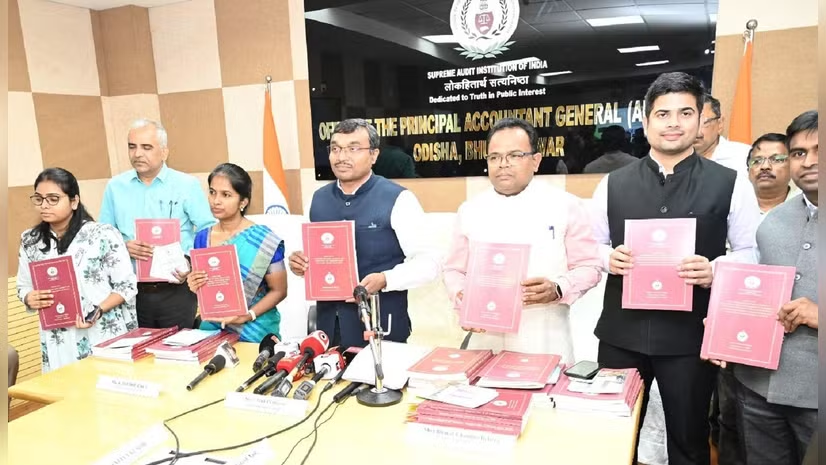
Bhubaneswar: The Comptroller and Auditor General (CAG) has criticised the Odisha government for serious lapses in revenue realisation and financial management, leading to non-remittance of over Rs 5,000 crore.
According to its latest State Finances Audit Report for 2024-25, which was tabled in the Odisha Legislative Assembly, 27 profit-making State PSUs failed to remit dividends totalling Rs 5,146.76 crore, in clear violation of the state’s dividend policy. The Finance Department did not even raise demands for these outstanding dues, pointing to serious deficiencies in oversight and enforcement.
Profit Growth Overshadowed by Heavy Losses
The audit report revealed that 18 SPSUs posted a combined profit of ₹7,073.21 crore in 2022–23, a significant increase from the ₹3,289.86 crore earned by 21 SPSUs in 2021–22. The top performers included Odisha Mining Corporation Limited (OMC), Odisha Hydro Power Corporation Limited (OHPC), Odisha State Police Housing and Welfare Corporation Limited (OSPHWC), and Odisha Forest Development Corporation Limited (OFDC). Return on Equity (ROE) also improved notably, rising to 31.19% in 2022–23 (across 18 SPSUs) from 22.37% in 2021–22 (across 21 SPSUs).
However, seven SPSUs recorded losses totalling ₹794.98 crore in 2022–23, higher than the ₹453.11 crore loss reported by SPSUs in the previous year. These losses were largely concentrated in two entities: GRIDCO Limited, which accounted for ₹778.18 crore, and Odisha State Road Transport Corporation (OSRTC), which incurred a loss of ₹10.55 crore. As of 31 March 2023, eight SPSEs had accumulated losses amounting to ₹9,449.38 crore. The net worth of four SPSEs was fully eroded, resulting in a negative net worth of ₹5,735.80 crore, despite a total equity investment of ₹3,428.80 crore in these entities.
Overall, the combined net worth of all 29 SPSEs stood at ₹17,311.65 crore as against a paid-up capital of ₹9,316.53 crore.
Budget Utilisation and Expenditure Issues
Budgetary performance came under scrutiny as well. Against a total provision of ₹2.87 trillion, the state utilised only ₹2.31 trillion, resulting in unspent savings of ₹56,157 crore (about 19.5 per cent of the budget). The CAG attributed this under-utilisation to unrealistic budgeting, inflated provisions, and inadequate implementation capacity in several departments, including Sports and Youth Services, and Panchayati Raj and Drinking Water.
The report also flagged the non-regularisation of excess expenditure amounting to ₹386.84 crore over multiple years, which violates constitutional requirements under Article 205.
Debt and Repayment Pressures
On the liabilities front,
while the overall debt-to-GSDP ratio improved to 15.48 per cent (well below the 25 per cent ceiling), the state faces substantial near-term repayment obligations. Around ₹76,642 crore, constituting 56 per cent of total borrowings, is due for repayment over the next seven years, raising concerns about refinancing risks and liquidity. The CAG noted that debt sustainability, which had strengthened until 2022-23, weakened thereafter due to rising borrowings and persistent primary deficits.
Financial Reporting and Fund Management
Serious deficiencies were observed in financial reporting and fund management. The state accumulated undischarged liabilities of ₹911.97 crore, including unpaid interest, pension contributions, and cess transfers. Additionally, ₹2,499.76 crore remained parked in Single Nodal Agency (SNA) bank accounts, undermining efforts to streamline fund flow under the SPARSH system. Pending utilisation certificates (UCs) surged to ₹16,585.45 crore across over 12,000 cases, while AC/DC bills pending for adjustment rose sharply by 171 per cent over five years, increasing risks of misappropriation. Irregular parking of funds in Personal Deposit accounts stood at ₹11,417.84 crore as of March 2025, with a significant portion transferred in the last two months of the year without immediate need.
Expenditure Patterns
Revenue expenditure continued to dominate, accounting for 87.69 per cent of revenue receipts. While committed expenditure showed some decline, subsidy outgo jumped by over 121 per cent to ₹9,134 crore, largely due to schemes such as Samrudh Krushak Yojana. Capital expenditure improved to ₹45,481 crore (22 per cent of total expenditure), but the audit pointed to misclassifications, including ₹721 crore of revenue nature booked as capital, and transfers to personal ledger accounts without prompt utilisation.
Economic Performance and Revenue Concerns
Odisha’s economy recorded moderate growth of 11.4 per cent in 2024-25, with GSDP rising at a compounded annual growth rate of 13.3 per cent from ₹5.4 trillion in 2020-21 to ₹8.9 trillion. The state maintained a revenue surplus of ₹22,651 crore (2.54 per cent of GSDP) and contained its fiscal deficit at ₹25,042 crore (2.81 per cent of GSDP), within the 3 per cent limit.
However, the CAG expressed concern over underlying vulnerabilities. Revenue receipts grew by just 2.43 per cent to ₹1.84 trillion despite robust economic expansion and higher central tax devolution. Own-tax revenue buoyancy plummeted to a negligible 0.02, while overall revenue buoyancy fell to 0.21. Non-tax revenue also declined, primarily due to poor dividend collections.
The report warned that weak own-tax mobilisation, under-realisation of revenue, and mounting repayment pressures could constrain fiscal space in the coming years if not addressed promptly.
The CAG has recommended stronger revenue mobilisation efforts, improved budget credibility, timely recovery of dues from SPSUs, and greater transparency in financial reporting and fund utilisation to safeguard Odisha’s long-term fiscal health.