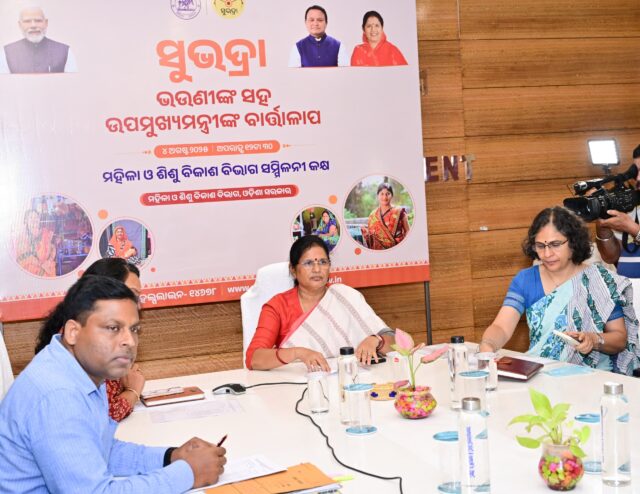
Bhubaneswar: In an effort to bring financial independence among women, the Odisha government is set to facilitate Rs ten lakh interest-free loans for members of Self-Help Groups (SHGs), recognised under the ‘Lakhpati Didi’ initiative.
Deputy Chief Minister Pravati Parida announced this while interacting with beneficiaries of the Subhadra scheme. She emphasised that the state government is committed to transforming Lakhpati Didis into Crorepati Didis through sustained financial support and entrepreneurship.
“The state government is committed to transform Lakhpati Didis into Crorepati Didis. Steps are being taken to facilitate Rs 10 lakh interest-free loans to the Lakhpati Didis through the women self-help groups (SHGs),” said Parida, who also holds the Women and Child Development (W&CD) portfolio.
The Union government, in association with the state government, launched the ‘Lakhpati Didi’ initiative with an motive to make women members earn an income of Rs one lakh annually.
The Deputy CM also asked the beneficiaries of Subhadra Yojana to write to the (W&CD) department giving detailed presentation on the utilisation of the money received through the scheme.
“Successful business models of the beneficiaries to be displayed in the Subhadra website of the state government,” she said during the virtual interaction.
Parida emphasised the growing strength of rural digitalisation and women economic empowerment through the Subhadra platform. She noted that Odisha’s women are increasingly helping one another through a structured value-added chain of cooperation, leading to collective growth and self-reliance.
The Deputy CM reiterated that the core objective of the Subhadra Yojana is to make women economically self-sufficient. Today, many women have started pursuing their dreams through this initiative.
To make the scheme even more effective, she invited beneficiaries to write directly to her or the Department with well-considered suggestions. In her address, she engaged in conversations with several successful Subhadra beneficiaries from different districts who shared their entrepreneurial journeys.