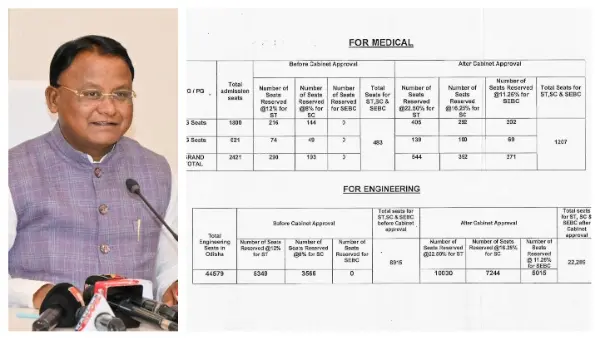
Bhubaneswar: In a major step toward promoting social justice and equitable access to education, the Odisha Cabinet, chaired by Chief Minister Mohan Majhi, approved a revised reservation policy for admissions to medical, engineering, and other professional and higher education courses late on Saturday.
The policy introduces an 11.25% reservation for Socially and Educationally Backward Classes (SEBC) in these streams for the first time. It simultaneously raises the quota for Scheduled Tribes (ST) from the previous 12% to 22.50% and for Scheduled Castes (SC) from 8% to 16.25%.
This brings the overall reservation structure in professional courses closer to the state’s demographic proportions, where STs and SCs together form a significant portion of the population but had previously received lower quotas in technical fields. SEBC students, who already benefit from 11.25% reservation in general higher education, had no dedicated quota in medicine, engineering, and allied professional programmes until now.
Impact on Seat Allocation
The changes will apply across state universities, affiliated colleges, ITIs, polytechnics, and a broad range of courses including medicine (MBBS, BDS, etc.), engineering, management, pharmacy, allied health sciences, agriculture and architecture.
For medical seats (2,421 U
G and PG seats), the revision means:
ST seats will rise from about 290 to 545.
SC seats will increase from roughly 193 to 393.
272 seats will be newly allocated to SEBC students.
Similar proportional gains are expected in engineering admissions (out of 44,579 seats), with around 10,030 for ST, 7,244 for SC, and 5,015 for SEBC.
Chief Minister Majhi described the decision as a corrective measure to address historical disparities and ensure greater inclusion for disadvantaged communities in high-demand professional education.
Other Key Approvals
In addition to the reservation reforms, the cabinet approved the distribution of additional fortified rice — an extra 5 kg per family per month, free of cost — to beneficiaries under the National Food Security Act (NFSA) and State Food Security Scheme (SFSS). This initiative, implemented in phases across all districts with a focus on vulnerable and tribal areas, is fully funded by the state budget. It aims to bolster food security, particularly during festive periods and lean agricultural seasons, benefiting lakhs of economically weaker families and reducing distress.
The cabinet also sanctioned a Comprehensive Flood Management Scheme with a total outlay of Rs 2,781 crore, to be executed over five years (2025-26 to 2029-30). Given Odisha’s frequent exposure to floods, cyclones, and storm surges, the scheme combines structural measures such as strengthening embankments, restoring drainage systems, and coastal protection with non-structural interventions, (including better flood forecasting and community preparedness. The plan seeks to minimise flood-related damages and enhance long-term resilience across the state.