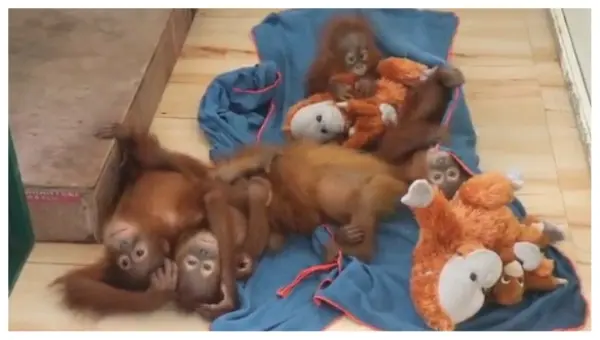
Bhubaneswar: A comprehensive medical evaluation, including X-rays and blood sampling, was conducted on five rescued infant orangutans at the Nandankanan Zoological Park in Bhubaneswar on Wednesday to assess their individual health parameters and enable DNA testing.
The health check-ups were carried out twice in 24 hours after one of the young primates suffered a temporary, stress-induced fever, though all five animals have since stabilised.
“Diagnostic procedures including X-rays, stool and urine examinations, thermal imaging, and blood tests assessing parameters such as haemoglobin and white blood cell counts confirm that all five infants are currently in stable condition, with body temperatures maintaining normal levels between 98.0°F and 99.0°F,” said Sanath Kumar N, director of Nandankanan Zoological Park, where the primates remain under strict veterinary supervision in a specialised, climate-controlled quarantine complex after being rescued from Balasore’s Bhograi area on September 8 morning.
The animals are being fed milk every two hours, along with apple and banana fluids and boiled potatoes at regular intervals, according to a dietary chart prepared by experts.
The blood samples will further support DNA testing once a suitable laboratory is identified, as few facilities maintain standard orangutan DNA profiles for comparison.
Aditya Acharya, head of the Centre for Wildlife Health at Odisha University of Agriculture and Technology, noted that high body temperatures in orangutans are monitored and treated similarly to humans, typically using paracetamol-based medications. He emphasised that the animals’ well-being remains the priority and that zoo authorities will decide the timing and destination of the DNA samples.
The test is expected to help establish the primates’ origin and assist the ongoing investigation. Incidentally, Indonesia’s Ministry of Forestry has reached out to Indian authorities and “preparing the technical requirements” for their repatriation if investigations confirm they are native to their country.
Meanwhile, a joint investigation launched by the Special Task Force (STF) of the Odisha Police Crime Branch and the Wildlife Crime Control Bureau (WCCB) into suspected cross-border trafficking appears to have hit a roadblock. Early momentum build after investigators analysed footage from more than 50 CCTV cameras along the Digha-Chandaneswar-Bhograi corridor, tracing the suspicious movements of a black Mahindra Thar SUV on the night of September 7. Raids across 50 hotels in neighbouring Digha, West Bengal, led to the questioning of several individuals and brought hotel owner Jayanta Maity and his son Soumyadeep Maity under scrutiny after CCTV recording equipment was found missing. Three hotel staff members were briefly detained before being released due to lack of direct evidence.
The infants, weighing between roughly 2 kg and 5 kg, were discovered by local Van Suraksha Samiti members near Badapali village in Bhograi block. They were initially mistaken for native monkeys, but forest officials quickly identified them as orangutans, a critically endangered species native exclusively to the tropical rainforests of Borneo and Sumatra. Because the young apes were far too small to have traveled on their own, authorities suspect they were dumped during a failed transit attempt linked to an international exotic pet smuggling network.
Following the rescue, the Odisha government formed a five-member technical committee to oversee their care.
Reacting to the alleged slow pace of the probe, Bhograi MLA Goutam Budha Das criticised the state investigation for moving in circles and urged the government to hand the case over to a national agency such as the Central Bureau of Investigation (CBI) or National Investigation Agency (NIA), arguing that international smuggling syndicates require centralised, cross-border intervention. For now, as law enforcement agencies analyse mobile tower records and port movements, zoo officials continue to monitor the five young apes with plans to transition them into larger open-space quarantine enclosures as their recovery progresses.