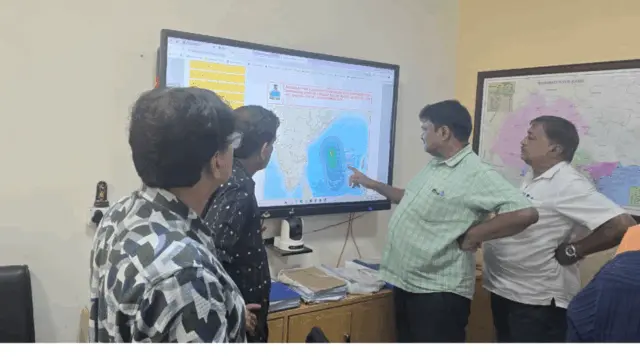
Bhubaneswar: Amid fear of another cyclone, the Odisha government has stepped up flood preparedness across the state in anticipation of possible heavy rainfall and increased river flows under the impact of the weather system.
The state government swung into action after the India Meteorological Department (IMD) said that the depression over the Bay of Bengal is likely to intensify into a cyclone on Monday and subsequently strengthen further into a very severe cyclonic storm.
The Department of Water Resources (DoWR) has initiated precautionary measures, including a review of reservoir storage, anticipated inflows and water management strategies, to tackle any emerging situation.
A high-level virtual meeting was held under the chairmanship of Engineer-in-Chief, Water Resources, Dillip Kumar Rout, to assess preparedness and finalise operational measures ahead of the anticipated weather system.
Senior officials, including the Engineer-in-Chief, Planning and Designs; Engineer-in-Chief, Schemes and Monitoring; Chief Engineer, RBVN; Additional Chief Engineers and Superintending Engineers concerned, attended the meeting.
The review focused on the likely rainfall pattern, possible rise in river levels, expected reservoir inflows and strategic regulation of reservoir water to minimise flood risks.
Special attention was given to the increased water storage in eight medium reservoirs in Ganjam district and two in Gajapati district following Cyclone Arnab.
Taking into account the existing storage levels and the evolving weather outlook, the department finalised a Standard Operating Procedure (SOP) for reservoir operations and preparedness during the forthcoming weather event.
Officials were directed to ensure continuous monitoring of reservoir levels, maintain close coordination among divisions and take timely decisions to address any eventuality. Field-level personnel were also asked to remain on high alert and be ready to initiate immediate action whenever required.
The department said anticipatory planning, precautionary measures and coordinated response would remain its key priorities to protect critical water infrastructure and downstream habitations.