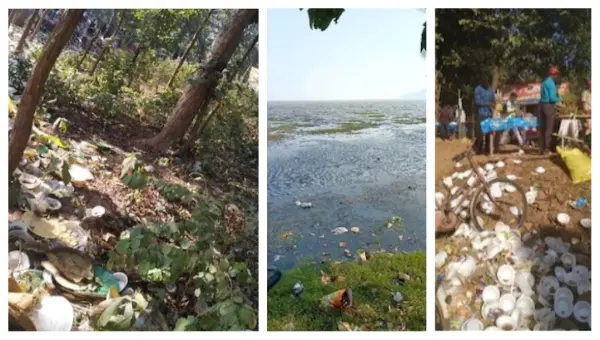
Odisha, once India’s best-kept secret, is fast becoming one of its most littered states. We are blessed with breathtaking landscapes—rivers, mangroves, lush green fields, pristine beaches, dense forests, majestic mountains, cascading waterfalls, ancient heritage sites, and magnificent temples.
Serene beauty surrounds us everywhere. Yet we enjoy this lush greenery by relaxing with families on picnics, blasting music, and leaving behind heaps of disposables. Mutton curry is the star of the feast, but plastic seems to be our real saviour, isn’t it?
Well, we carry all sorts of single-use plastics, water bottles, soda bottles, plastic bags, disposable glasses, the worst are disposable plates and bowls, straws, which make our life so easy. Worst of all are the foam cups, plates, containers, and bowls—the most hazardous to the environment—because we don’t have to wash dishes afterwards. Just eat and throw!
“Kahin pe bhi phek do”, “Khidki kholo aur phek do”!! Yahi seekhte hain na hum? We beautify the entire landscape by littering them. Who cares if they break down and finally enter our own food system, our blood vessels and slowly poison the entire human race? Forget what happens next, isn’t this our culture now?
Have fun, leave the garbage there, this is our culture now!
The plastics we use daily are numbered so that they can be recycled properly. Plastics pose a huge threat if not managed properly. They cause environmental hazards like pollution. Littered plastic contaminates waterways as it is never collected or cleaned. Then it reaches the ocean and harms both fresh water and marine life. Breakdown of plastics releases micro plastics, which can be ingested by animals and enter the food chain. Plastics take hundreds of years to decompose, occupying landfill spaces and leaching chemicals. Certain plastics like PVC and PS, contain harmful chemicals like BPA, phthalates, and styrene, which can leach into food and water. Some plastics like PVC and PS have been linked to cancer risks. Burning plastics can release toxic fumes, causing respiratory problems.
pose, occupy vast landfill space, and leach toxic chemicals. Certain types like PVC and PS contain harmful substances such as BPA, phthalates, and styrene, which can seep into food and water. Some have been linked to cancer risks. Burning plastics releases toxic fumes that cause respiratory illnesses.
Awareness on plastics and their ways of recycling, to reduce their hazardous effects is extremely important. Our children should be our first priority. We can no longer remain ignorant when climate change is happening, temperature is rising, weather of all places are changing, strange weather phenomenon is happening, hospitals are growing and medicine shops now outnumbering grocery stores.
It is high time that we care for our neighbourhood, and for those villagers whose orchards and river sides we are spoiling with littered waste. If we consider ourselves human, we must take responsibility for fellow humans, for our forests, and for the animals that not only enhance their beauty but also play a key role in preserving our food security. We pay thousands to glimpse endangered species—yet we destroy their habitats.
Last but not the least my question to all is, don’t you see littered waste everywhere? Doesn’t it bother you? Who is responsible to clean it? The Sarpanch, the Tehsildar, the Sub Collector, the Collector/ District Magistrate, the Forest department or the National Highway Authorities, the PWD or the Panchayati Raj?
From the cashew reserve forests near Puri to Puri Beach, Chandrabhaga, Konark, Deomali, Chilika, riverbanks, picnic spots, jungle trails, waterfalls, canals, and urban streets—every beautiful place is choked with plastic. We look up at the scenery but refuse to look down at the filth beneath our feet. Doesn’t this picture make you sad?
Where are we heading to, at this reckless pace of polluting Mother Earth? Do we even realise?
STOP LITTERING! STOP CONSIDERING INDIA AS A GARBAGE BIN!
STOP & RETHINK BEFORE YOU THROW A CHIPS PACKET OUTSIDE YOUR WINDOW!
STOP! THINK! STOP, FOR THE SAKE OF OUR CHILDREN!
On the eve of India’s independence, Mahatma Gandhi was asked whether he thought the country could follow the British model of industrial development. His response is very relevant in today’s context. He said, “It took Britain half the resources of this planet to achieve its prosperity. How many planets will India require for development?” About 700 million out of 1.1 billion population live in rural areas and are directly dependent climate sensitive sectors like agriculture, forests and fisheries. They derive their subsistence and livelihood from natural resources such as water, biodiversity and grasslands. Therefore, pollution affects their livelihood as toxins leach the agricultural lands, water bodies and finally rivers and oceans. They affect productivity and hence livelihood. They give health hazards to all organisms including humans who are most effected being at the top of the food chain. “As we sow, so we reap”!