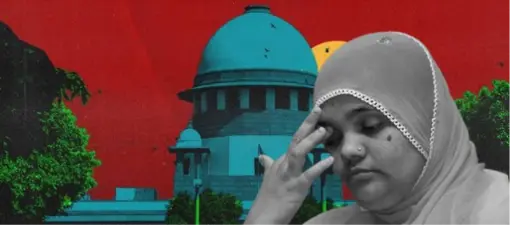
New Delhi: Bilkis Bano, who survived gangrape and the murder of her family during the 2002 Gujarat riots, has said she was left “in pain, shock and disbelief” after learning from media reports that the Supreme Court had suspended the life sentences of two men convicted in her gang-rape case and released them on bail.
She alleged that the order was issued without informing her or giving her an opportunity to be heard.
In a statement issued through her lawyer, senior advocate Shobha Gupta, Bano said the development had reopened fears she had spent years trying to overcome. She said she had first fought for justice as a 19-year-old, after losing her three-year-old daughter, Saleha, and seven family members in the violence that followed the 2002 Gujarat riots.
“I make this statement even when words come slowly through fresh tears of pain, shock and disbelief. I still cannot believe that once again, for the second time, an order has been passed by the Supreme Court without calling me up and without hearing me. I learnt of this through press reports…” she said.
“I was a young girl, just 19 years old, when my world, my baby daughter, my family, my home, my trust in humanity was brutally wrenched from me. For 24 long years since that day, I have stood up to fight for justice, for myself and for women everywhere, again and again and again. For 24 years I have searched for and found reservoirs of courage I did not know I had, only because a million voices of support and solidarity came my way,” Bano said.
Court’s Interim Relief
A bench of Justices M.M. Sundresh and Prasanna B. Varale passed the order on October 28, which was made public on Monday. The court noted that Bipinchand Kanaiyalal Joshi and Pradip Ramanlal Modhiya had been imprisoned for over 17 years and that one of them had a severe disability, while observing that questions of fact and law remained to be decided in their appeal, as reported by The New Indian Express.
“Having heard the parties, suffice it to state that the appellants have been under incarceration for a period of more than 17 years, and also the fact remains that one of the appellants has a severe handicap. Certainly, there are issues to be decided in the appeal, both on fact and law,” the Supreme Court said.
“In view of the above and considering the issues involved in this appeal, we suspend the sentence and grant bail to the appellants on such terms and conditions as may be imposed by the concerned trial court,” the bench added.
The order does not set aside the convictions. It suspends the life sentences only while the appeals are pending, with the trial court to determine the conditions of bail.
‘Familiar Fears Are Resurfacing’
Bano questioned how the Court could grant such relief without ensuring that she was informed or heard. She said that after years of courtroom battles, she had begun to rebuild her life and regain a sense of peace, but the latest order had revived fear for herself, her family and her children.
“I have walked to courtroom after courtroom, and been grateful each time I was vindicated; each time my faith in the idea of justice was restored. I have rebuilt from the rubble of my life, with the love of family and friends. I have yearned for peace. I have learned to smile,” she said.
“Yet today I find myself losing the very justice I had fought so hard to win. Familiar fears are resurfacing. I am scared once again. For myself, my family, and my children. And I am scared of losing faith in justice, yet again. How could the honourable Supreme Court simply suspend the sentence of the men who did this to me? How could they not even inform me? How could they not even make sure my voice was heard in their courtroom?” Bano said.
She said she would contest the order because her children should not have to live with the fear and trauma it had brought back. Her statement also framed the fight as one for survivors and women more broadly.
“I do this for my three-year-old Saleha who deserved to live, and whose memory demands justice. I do this for women everywhere. Because no woman, no survivor, no citizen should have to endure this eternal test of belonging and equality, and fight for justice for the rest of her life,” she said.