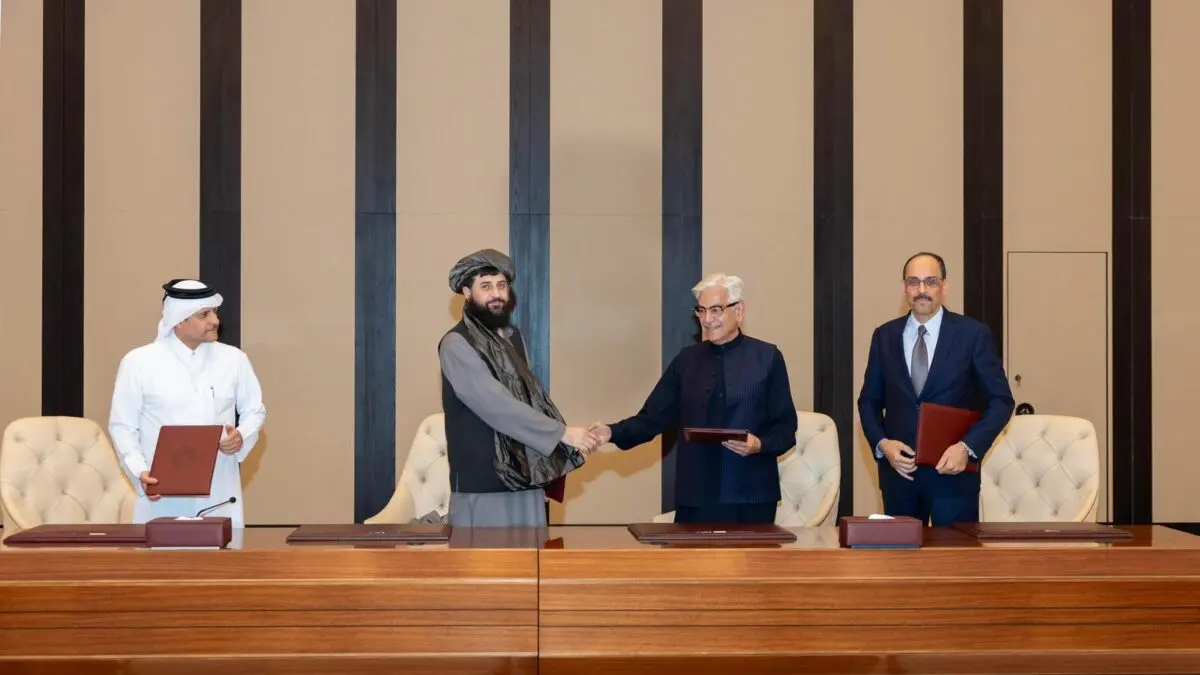
Doha/Islamabad/Kabul: Qatar on Saturday announced that Pakistan and Afghanistan have agreed to an immediate ceasefire, following urgent talks in Doha aimed at halting days of deadly cross-border fighting that has heightened regional tensions.
In a statement, Qatar’s foreign ministry said the discussions were held in a “positive and constructive atmosphere” and resulted in an agreement by both sides to stop hostilities at once. The talks, co-facilitated by Qatar and Turkey, brought together Pakistan’s Defence Minister Khawaja Muhammad Asif and Afghanistan’s acting Defence Minister Mullah Mohammad Yaqoob.
“The two parties agreed to hold follow-up meetings in the coming days to ensure the implementation and sustainability of the ceasefire,” the Qatari statement said.
Intense border violence preceded talks
The breakthrough comes after more than a week of fierce clashes along the 2,600-km Pakistan–Afghanistan border, which left dozens dead and forced hundreds to flee their homes. Islamabad accused Kabul of allowing Tehreek-e-Taliban Pakistan (TTP) militants to launch cross-border attacks, while the Taliban government in Afghanistan alleged that Pakistani airstrikes had targeted civilians.
The violence marked one of the sharpest spikes in hostilities between the two sides since the Taliban returned to power in 2021, drawing concern from the international community and prompting calls for restraint.
Qatar’s mediation role
Qatar, which has positioned itself as a key regional mediator since hosting the U.S.–Taliban peace talks, said it “welcomed the commitment shown by both parties” and reaffirmed its readiness to assist further in maintaining stability along the frontier. Turkey also played a supporting role in facilitating the dialogue.
Officials said the agreement includes a mechanism for verification and communication between both sides’ military representatives to address potential violations and prevent renewed clashes.
Fragile truce amid deep mistrust
While the ceasefire has been hailed as a diplomatic success for Doha, analysts warn that sustaining it will be difficult given long-standing mistrust and recurring accusations of cross-border aggression.
“This truce may cool tempers for now, but enforcing it will be the real challenge,” a South Asia security analyst told India Today. “Ground-level control and political will on both sides will determine if this pause leads to lasting calm.”
Follow-up discussions are expected to continue next week, likely in Istanbul, to work out broader border management and counterterrorism cooperation.