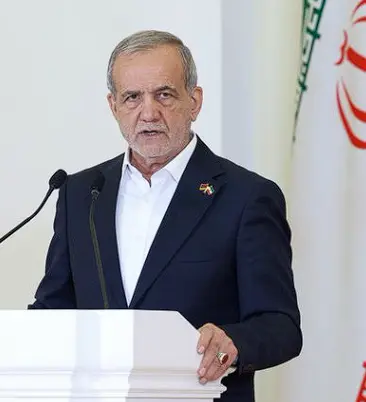
Tehran: Iranian President Masoud Pezeshkian has reportedly submitted his resignation amid an intensifying power struggle between the civilian government and Tehran’s military-security apparatus, Iran International reported on Sunday.
The letter, said to have been sent to the office of Supreme Leader Mojtaba Khamenei, was submitted as the United States and Iran continued work toward a draft agreement to end a three-month conflict that has shaken the region. Iran International, citing an unnamed source, reported that Pezeshkian told the supreme leader in his letter that he and his cabinet have been effectively excluded from major decision-making in the Islamic Republic, creating a vacuum that hardline factions within the Islamic Revolutionary Guard Corps (IRGC) have moved to fill, as reported by Mint.
The president argued that, under those conditions, he is unable to run the government or carry out his legal responsibilities and therefore requested to step down immediately, the source said. It remains unclear whether Mojtaba Khamenei will accept the resignation; Iran International described the contents of the letter as pointing to a deep and unprecedented rift at the highest levels of power.
Mounting Tensions
The reported resignation comes after months of mounting tensions between Tehran’s elected administration and the country’s military-security institutions. Observers and media reports have suggested that the IRGC has progressively curtailed presidential authority and assumed control over key elements of state governance.
According to Iran International, clashes between Pezeshkian and military leadership intensified in the wake of the 4 May escalation in the Persian Gulf and subsequent missile and drone strikes on the United Arab Emirates. Sources familiar with internal discussions in Tehran said Pezeshkian has voice
d deep frustration with operations carried out by the IRGC, which is led by Ahmad Vahidi.
Pezeshkian Blasts IRGC Strikes
He reportedly condemned those attacks as “completely irresponsible,” saying they were launched without the government’s knowledge or approval. The sources added that Pezeshkian characterized the IRGC’s strategy of raising tensions with regional states as “madness” and warned that it could produce consequences that may be impossible to reverse. With regional risks rising, Pezeshkian is said to have sought an urgent meeting with Mojtaba Khamenei to press for an immediate halt to IRGC attacks on Gulf states and to avert further escalation.
Earlier on Sunday, Pezeshkian posted a message on his official X account that many analysts read as signaling his mounting concerns and frustration. He wrote, “Confronting major challenges without enduring hardships is impossible. Crossing this rugged and winding path is only possible through public awareness and cooperation. We must explain the existing realities to the people so that all segments of society participate in solving problems. This shared pain will never be healed separately.”
Draft Advances; No Decision On Friday
The resignation report arrives during delicate US-Iran diplomacy aimed at ending months of open hostilities. Last week, US President Donald Trump wrote on Truth Social that an agreement with Iran was “largely negotiated,” indicating progress toward a ceasefire and settlement. But significant gaps remain: after a two-hour meeting on Friday to review a draft proposal reportedly sent by Tehran, officials left without a major decision.
On Sunday, Trump described Iranian officials as “very tough negotiators” and said the United States was taking a patient approach to secure a broader agreement, Fox News reported. In April, the president had called Iran’s leadership “seriously fractured,” citing internal divisions as one rationale for extending a ceasefire indefinitely just before a prior accord was due to lapse.
If Mojtaba Khamenei accepts Pezeshkian’s resignation, the move would mark a dramatic turning point in Tehran’s internal power dynamics and could further complicate the diplomatic track aimed at sealing a lasting settlement. If he rejects it, the episode would nonetheless expose a pronounced split between the presidency and the IRGC at a time when unity in decision-making is widely viewed as crucial to de-escalating regional tensions.