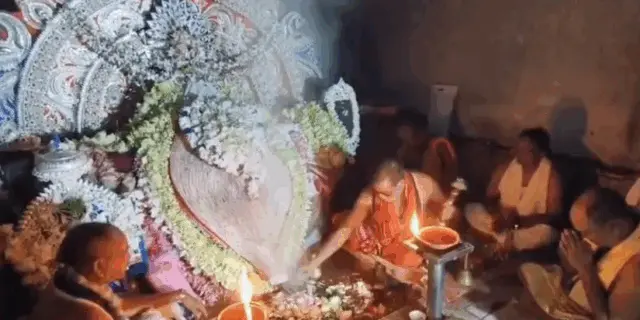
Bhubaneswar: Devotees thronged temples across Odisha in large numbers on Saturday as Mahalaya Amavasya marked the conclusion of Pitru Paksha, the sacred fortnight dedicated to remembering departed ancestors.
From the rare Dhabalamukhi Besha of Maa Sureswari and Maa Samaleswari to ancestral offerings at Shree Jagannath Temple in Puri and Jajpur’s Nabhi Gaya, devotees gathered to observe the auspicious day.
Mahalaya holds special religious significance in Hindu tradition, as families perform shraddha, pindadan and tarpan to pray for the peace and salvation of their ancestors.
In Sambalpur, devotees thronged Samaleswari temple to witness the rare and sacred ‘Dhabalamukhi Besha’ of Goddess Samaleswari on the occasion of Mahalaya Amavasya
Unlike her fierce and warrior-like appearances in other rituals, ‘Dhabalamukhi Besha’ presents the Goddess in a calm and serene form. Here, the presiding deity is coated in a white paste made from conch and gopi tilak, dressed in a white saree, and embellished with white flowers. She adorns the avatar, symbolising peace, purity, and divine grace, for only two-and-a-half days in a year.
The darshan started early in the morning after Mangala Aalati, and the Pahada Niti of the Goddess will be performed at around 10:30 pm.
Mahalaya, which occurs seven days before Durga Puja, signals the arrival of Maa Durga accompanied by her children to her maternal home on Earth from Mount Kailash.
Similarly, at the shrine of Maa Sureswari, the presiding deity of Subarnapur, devotees gathered to witness the Goddess in her rare Dhabalamukhi Besha.
While Maa Sureswari is traditionally worshipped in a vermilion-coloured form throughout the year, she appears in white only on Mahalaya. The special appearance is also known as Ganga Darshan and is associated with the form of Goddess Saraswati.
As the Goddess appears in this distinctive form only once a year, a large number of devotees visited the temple to seek her blessings.
According to the temple tradition, the rare darshan will remain available for two-and-a-half days from Mahalaya.
Meanwhile, thousands gathered at the shrine of Goddess Maa Biraja in Jajpur district and Shree Jagannath Temple in Puri to perform Shraddha and Pinda Daan rituals to ensure peace and salvation for departed souls, on the last day of Pitru Paksha. On this occasion, people offer pindas made of flour, rice, and even Mahaprasad to their forefathers as part of the sacred rites.
Special arrangements to ensure security and crowd management at these sacred sites.
Mahalaya is considered one of the most significant days for ancestral worship, particularly for families whose ancestors’ death-tithis are unknown or whose shraddha rituals could not be performed earlier.