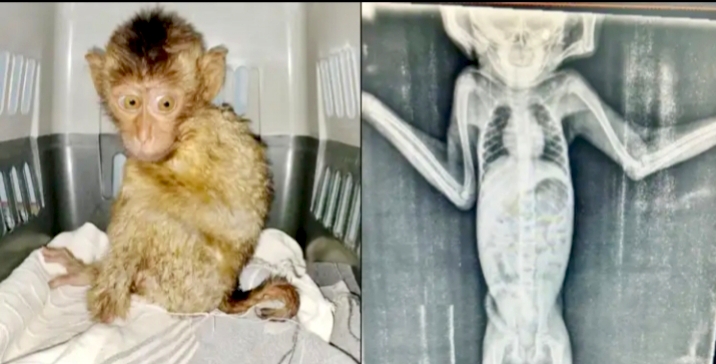
Mumbai: Recently, a scan of the baggage of an incoming passenger at the Chhatrapati Shivaji Maharaj International Airport in Mumbai revealed something strange. There was a live animal packed inside.
The young, pig-tailed macaque that was taken out was barely alive. It had a pellet lodged in its skull. A clear indication that it had been poached from the wild and was not from a farm where such animals are bred in captivity. A veterinarian in Mumbai managed to extract the pellet and save the animal’s life, but it exposed the gory truth of illegal animal trafficking to India, to meet the demands of private collectors.
According to data collected by the NGO RAWW, Mumbai Customs intercepted 377 exotic wild animals at the international airport in 2025 alone. The most trafficked exotic species were reptiles, led by Green Iguanas, followed by Indonesian Pit Vipers and Central Bearded Dragons.
Pawan Sharma, founder and president of RAWW, told Mid-Day that the current trends in illegal wildlife trafficking are extremely alarming.
“Earlier, most trafficked animals were captive-bred species. However, current trends show a disturbing rise in the number of wild-caught species being trafficked,” he said.
“There is growing demand for wild-caught animals in both local and international markets. Breeders often seek wild individuals to maintain genetic diversity and avoid inbreeding, which helps ensure the offspring are healthier and free from genetic defects. This is a serious issue that requires thorough investigation and urgent action,” Sharma added.
“This year alone, we encountered several wild-caught animals based on their physical condition, behavioural traits, and appearance, which clearly differed from those bred in captivity,” Sharma said, adding: “We also recorded significant mortality among wild-caught individuals due to capture myopathy and captivity stress, which are rare in captive-bred animals accustomed to human handling and confined spaces like baskets, cages, and breeding boxes.”
Dr Rina Dev, the senior veterinarian associated with RAWW, shared the incident of the pig-tailed macaque. “The primate was brought in severely dehydrated and unable to hold his head and neck upright. Initially, we thought this was due to extreme stress and exhaustion. But an X-ray revealed something more disturbing, a gun pellet partially lodged in his skull,” she said.
“A delicate surgery was urgently performed to remove the pellet, and the animal was placed under intensive care. Over the following weeks, he gradually recovered with dedicated treatment,” Dr Dev said.
The case of the animal is a grim reminder of the violence inherent in this trade. In a recent incident, over 2,500 red-eared sliders (a freshwater turtle) smuggled into India were repatriated to Singapore, only to be euthanized due to Salmonella.
“A bullet in a pig-tailed macaque makes me think not just of the pain, suffering, and mental trauma the animal has endured, but of a broken system. On one end, we have vulnerable local communities being exploited; on the other, ignorant exotic pet owners fueling this demand. In between are overwhelmed enforcement agencies and gaps in policy. The only way forward is cross-sectoral collaboration, across borders, disciplines, and jurisdictions, to address every facet of this crisis. That’s the only way we stand a chance at countering this heinous crime,” conservation filmmaker working on wildlife trafficking awareness Trishala Ashok said.
“It is shocking that so many different exotic species, from large monkeys to spiders, are being smuggled into India. Why the sudden rise in routing these animals through Mumbai? Isn’t it obvious such consignments would be caught by Customs? Are the smugglers so naive as to overlook this? A detailed investigation is needed to determine the intended destination of these animals-was it for personal collections or for privately-owned zoos in India? Hopefully, the truth will come out soon. Good work by the Customs Department in intercepting these consignments and rescuing the animals. I hope efforts are also being made to send the healthy ones back to their countries of origin,” Kedar Gore, Wildlife Conservationist of The Corbett Foundation, told Mid-Day.
The media outlet has quoted Yogesh Warkad, deputy director, Wildlife Crime Control Board as saying: “The high demand for exotic wild animals in India is undeniable. However, the spike in seizures is also due to improved intelligence gathering, which has increased detection of wildlife trafficking crimes. In most cases, animals seized at Mumbai International Airport by Customs are repatriated to their countries of origin. If they cannot be returned, they are sent to Central Zoo Authority (CZA)-approved zoos.”