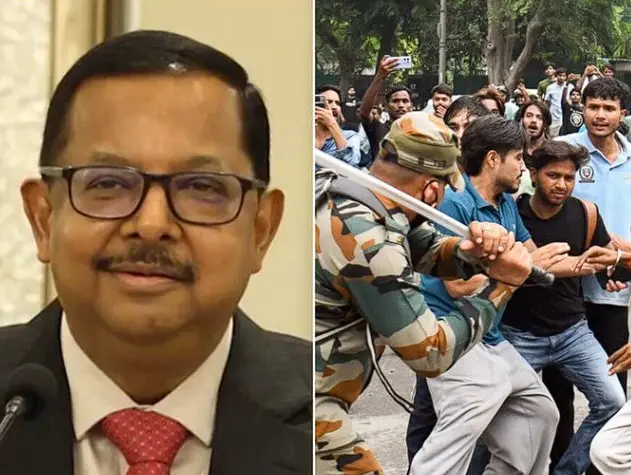
New Delhi: A Supreme Court judge on Friday voiced sharp concern over reports of police personnel allegedly beating protesters during the recent NEET students’ demonstration at Jantar Mantar, warning that the sense of detachment expected from law enforcement officials seems to be eroding.
Justice Ujjal Bhuyan, speaking at the release of former secretary (security) Yashovardhan Azad’s book ‘Policing the Republic’, said: “All of us are dismayed when we see young officers of the Indian Police Service personally going and assaulting protesters and demonstrators. This is something very, very distressing to observe.”
“The detachment expected of police officers somehow seems to be disappearing, and this is indeed a matter of grave concern,” he added.
The event was held at Viceroy Hall in the national capital, with Congress MP P Chidambaram, former Maharashtra DGP D Sivanandhan and others in attendance, as reported by The New Indian Express.
Justice Bhuyan emphasised that policing can be carried out effectively without resorting to excessive force or violating human rights.
“For most common people, a policeman on the street wearing a whistle and a lathi represents the power and authority of the state. When they feel wronged, they seek the help of the police. It is, therefore, of utmost importance that the police force maintains its credibility,” he said.
“It can do so only by strictly adhering to the Constitution, by functioning as a truly professional force, acting impartially, displaying courage and acting with conviction, maintaining integrity and adhering to secular principles, thereby upholding the rule of law,” he added.
He also drew attention to the growing number of custodial torture cases and deaths across the country, calling them among the gravest offences in a civilised society.
“Custodial death is perhaps one of the worst crimes in a civilised society governed by the rule of law. Any form of torture, of cruel, inhuman, or degrading treatment would fall within the inhibition of Article 29, whether it occurs during investigation, interrogation or otherwise,” he said.