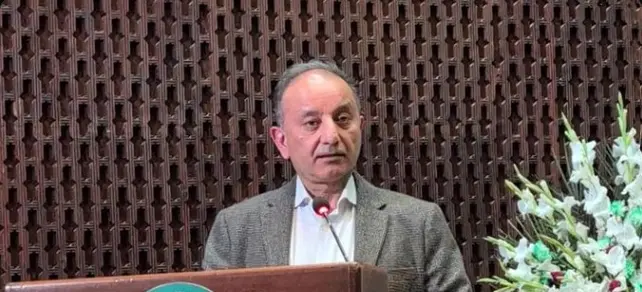
New Delhi: Pakistan’s Climate Change Minister Musadik Malik used Delhi’s Purana Qila to speak about shared history at the SCO Civilisational Dialogue Forum on Saturday. He referred to Mughal emperor Humayun and Afghan ruler Sher Shah Suri, both linked to the fort, to show how different rulers and cultures have shaped the same place.
Speaking at the session on “Civilisational and Cultural Expressions,” Malik said the fort shows how different historical identities came together. He said Humayun, who had Central Asian and Timurid links, began the fort, while Sher Shah Suri, an Afghan ruler, later added to it.
“This Qila, where we are sitting, is in itself a story. A fort whose foundation was laid by Humayun, who had a descent from the Timurid dynasty linkage and came from Central Asia. Sher Shah Suri further built on it, who was an Afghan. One wall, two rivals, meaning two rulers and one fort, meaning two layers and one trench,” he said.
Malik’s office shared a video of his remarks on X, describing the Qila as a “story.”
Dialogue Amid Difference
Malik, visiting India for the first time since the 2025 Pahalgam terror attack, said dialogue is possible only between different identities and civilisations. He said the purpose of the forum was to allow such exchanges.
“Dialogue is between distinct identities, and between diversity, and we have come here for that dialogue only,” he said.
He explained that in Greek, “dia” means “through” and “logos” means “ideas.” Malik said dialogue means the free exchange of ideas between civilisations, and accepting diversity needs wisdom and courage.
India is hosting the three-day forum at Purana Qila from November 20 to 22. Prime Minister Narendra Modi inaugurated it on Friday in the presence of delegates from SCO member countries, including Pakistan.
Heritage As A Bridge
Union Culture Minister Gajendra Singh Shekhawat, who chaired the session, said shared cultural heritage connects SCO countries. He said history can bring nations closer and create chances for cultural cooperation, understanding and friendship.
“Our civilisations are not merely legacies of the past, but living traditions whose knowledge continues to illuminate our present and inspire future generations,” Shekhawat said.
He expressed hope that the forum would strengthen cultural ties and improve understanding among SCO member states, as reported by The New Indian Express.
India is using the historic site to show Delhi’s long history. A special exhibition, “Astitva — The Essence of our Existence,” displays archaeological evidence from 1,200 BCE to 1200 CE. It includes excavated remains, artefacts and architectural pieces.
Delegates also visited “The Light and the Lotus: Relics of the Awakened One” at the Qila Rai Pithora cultural complex in south Delhi on Saturday.
History Behind Metaphor
Purana Qila is traditionally linked with Indraprastha, the ancient city connected to the Mahabharata. Humayun developed the site as part of his capital, Dinpanah, while Sher Shah Suri, who displaced Humayun, continued building there.
On Friday, Modi called Purana Qila an extraordinary heritage site and said scholars trace its history to the Mahabharata era.
Malik said on Friday that his visit to India was for discussions in a multilateral setting. Asked whether the forum could improve India-Pakistan relations, he said the discussions were taking place in a multilateral context and stressed the role of culture in supporting dialogue between the two countries.