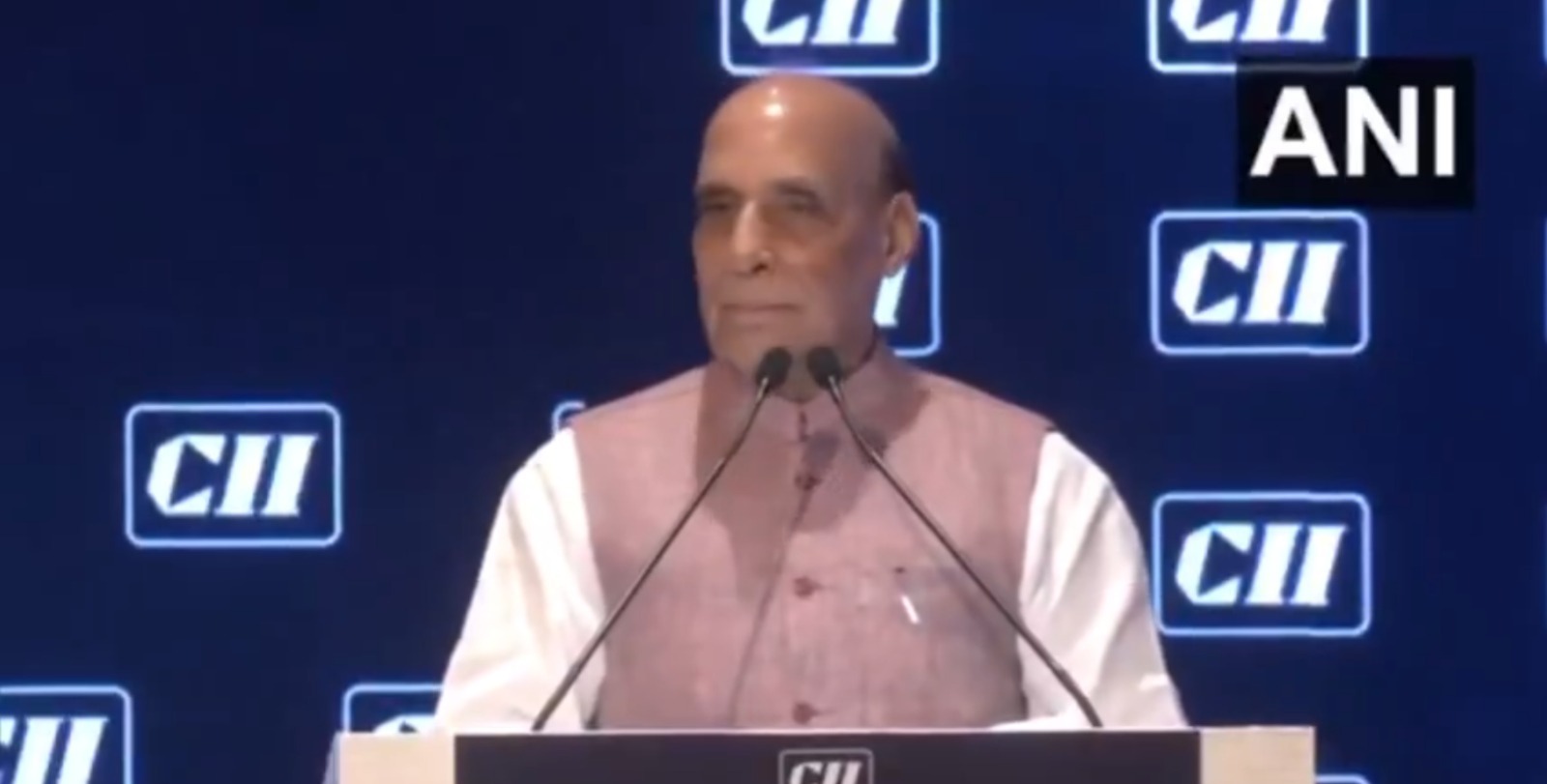
New Delhi: At the CII Annual Business Summit 2025, Defence Minister Rajnath Singh outlined a significantly recalibrated national security approach toward Pakistan, declaring a single-point agenda for future diplomatic engagement: terrorism and Pakistan-occupied Kashmir (PoK). The minister sent a clear and uncompromising message: India’s stance has hardened, and there is no space left for ambiguity or traditional bilateral dialogues.
“We have recalibrated our engagement and scope of dialogue with Pakistan. Now, whenever there will be talks, it will be only on terrorism and PoK,” Singh asserted.
PoK Is Family, Not Foreign: Emotional Appeal to Separated Kashmiris
In a rare public message directed at Pakistan-occupied Kashmir, Singh emphasized India’s enduring commitment to “Ek Bharat, Shreshtha Bharat.” Declaring the people of PoK as an integral part of India’s cultural and political identity, Singh said:
“I believe that the people of Pakistan-Occupied Kashmir are our own, part of our family… We have full faith that our brothers who are geographically and politically separated today will return to the mainstream of India.”
This was not just political rhetoric, but a strategic and emotional outreach, suggesting that reunification remains a core objective of India’s Kashmir policy.
Operation Sindoor: The Blueprint of a New Military Doctrine
Singh highlighted Operation Sindoor, India’s latest counterterror offensive, as a case study in proactive national security and a testament to the “Make in India” defence push. Launched on May 7, 2025, the operation saw Indian forces target and destroy nine terror camps across Pakistan and PoK, including:
Jaish-e-Mohammed bases in Bahawalpur
Lashkar-e-Taiba facilities in Muridke
“In Operation Sindoor, the people of the country have seen, understood, and felt the success of Make in India,” Singh said, crediting indigenous technology for precise strikes and tactical superiority.
He emphasized that without domestic defence manufacturing, India would not have been able to execute such an effective operation against cross-border terrorism.
Terrorism Is Now a Costly Enterprise for Pakistan
The minister drove home a key strategic message—India’s counterterror policy now aims to make terrorism economically unsustainable for Pakistan.
“Running the business of terrorism is not cost-effective. Today, Pakistan has realised it has to pay a heavy price,” Singh said.
This shift represents a doctrine of deterrence, where sustained military, economic, and diplomatic pressure aims to choke off Pakistan’s support for extremist groups.
No Talks, No Trade—Only Terror and PoK on Table
Echoing Prime Minister Narendra Modi’s recent remarks, Singh reiterated that India has ended business-as-usual diplomacy with Pakistan.
“There will be no talks and no trade with Pakistan. If there are talks, they will only be about Pakistan-occupied Kashmir,” PM Modi had said earlier.
This marks a fundamental departure from decades of policy that balanced trade, cultural exchanges, and peace dialogues alongside conflict management.
Strategic Pressure: Water Diplomacy Enters the Frame
In a pointed warning, Singh reminded Pakistan that India is considering blocking its share of river water that flows into its territory. This water threat, earlier hinted at by PM Modi, is part of India’s multi-pronged pressure strategy that includes:
Diplomatic isolation
Economic disengagement
Targeted military strikes
Water-sharing leverage
A Doctrine of Assertive Deterrence
Defence Minister Rajnath Singh’s address at the CII Summit was more than a policy speech—it was a doctrinal declaration. The message is clear: India no longer views Pakistan as a neighbor to be engaged diplomatically but as a security threat to be neutralized through calibrated military, economic, and strategic tools.
With Operation Sindoor as the blueprint and Make in India as the enabler, India’s new doctrine reflects a matured and muscular posture, aimed at long-term peace through credible deterrence and unwavering strategic clarity.