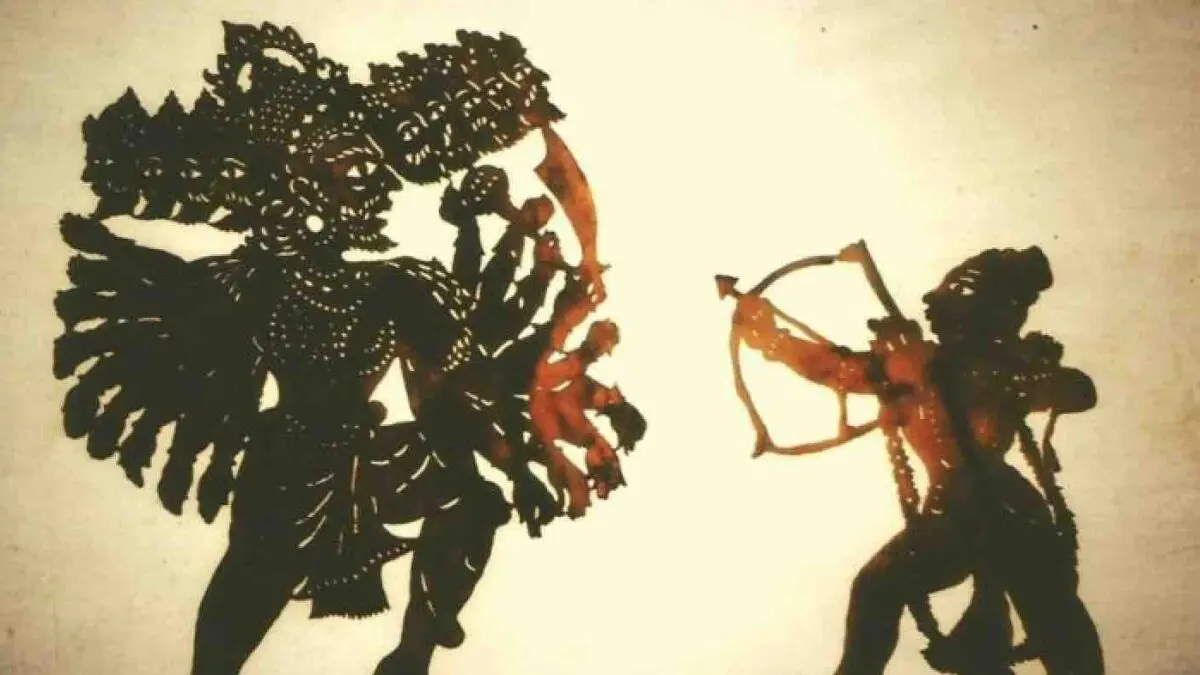
The transformation of the bioscope into modern motion pictures is recent, with the Lumière Brothers screening their first film in Paris on December 28, 1895. Yet Odisha boasts an indigenous precursor to cinema in shadow puppetry, an ancient art form as old as the region’s early civilisation.
Odisha holds the unique distinction in Indian as the state preserving all four traditional puppetry forms: glove, string, rod, and shadow. These include ‘Sakhi Kandhei Nata’ (glove puppets), ‘Ramaleela Kandhei Nata’ (rod puppets), ‘Gopaleela Kandhei Nata’ (life-size puppets), and the rarest of all: ‘Ravana Chhaya’ (shadow puppetry).
‘Ravana Chhaya’, meaning Ravana’s Shadow, is a distinctive tradition of shadow theatre. References to shadow plays appear in Odia literature, including Sarala Das’s 15th-century Mahabharata, Balaram Das’s 16th-century Ramayana, and works by 17th-18th century poets such as Dinakrushna Das, Upendra Bhanja, and Abhimanyu Samantasimhara. Terms like chitrapata (picture), pattachitra (applique), and bimba (shadow) often denote shadow performances. A rock painting at Sitabijh in Keonjhar district, dated between the 2nd and 4th centuries CE and locally known as Ravana Chhaya, depicts a royal procession, suggesting early traditions of visual storytelling.
However, lack of direct mention of ‘Ravana Chhaya’ in ancient texts has sparked scholarly debate. One theory links it to words like chhauni or chhatra (tent/canopy) evolving into “shadow picture”. A more convincing explanation comes from the performers themselves, according to whom Rama, as Purushottama and a divine, cannot be appropriately represented by shadow, making it improper to name the form after him. I
nstead, the tradition honours Ravana, the central antagonist whose shadow dominates the narrative.
A profound legend from puppeteers adds deeper resonance: When Sita’s companion urged her to sketch Ravana, she drew him from the memory of his reflection in the sea below, glimpsed during her abduction aboard the Pushpaka Vimana. That fleeting shadow foreshadowed her trials, the questioning of her chastity, and ultimately the triumph of truth over deceit. Thus, ‘Ravana Chhaya’ symbolises the victory of good over evil, embodied in the shadow of the villain.
The repertoire draws from Ramayana episodes, with a major revival in the 18th century tied to Biswanath Khuntia’s Bichitra Ramayana, which provided key stories and lyrics.
The puppets are crafted from untanned deer, sambar, or goat hide — flat, jointless plates manipulated with a lower prop. Ravana’s figure is notably larger than the others. A small ensemble of singers and musicians, playing the khanjani (tambourine), daskathi (wooden clappers), mridangam, and cymbals, provides rhythmic accompaniment that blends folk and classical Odissi elements. Puppeteers work behind the screen, casting shadows in perfect sync with music and song.
The stage is a simple cube (about 8–10 feet per side) framed by wooden poles or pipes, draped in thick blue or black cloth on three sides and the lower front. A white cloth screen forms the upper front half (roughly 8 feet wide by 4 feet high), where shadows come to life. The lower front is covered by a thick mat holding less-used puppets and doubles as a resting place for performers. A hidden light source in the center ensures that only the screen is visible to the audience seated in darkness.
Today, this rare art survives primarily in villages like Odasha and Kutarimunda in Angul district, where dedicated troupes and institutions, such as Ravan Chhaya Natya Sansada (established in 1982), keep the tradition alive amid modern challenges.
‘Ravana Chhaya’ is more than puppetry, it’s Odisha’s poetic shadow narrative, where light and darkness weave timeless tales of dharma.