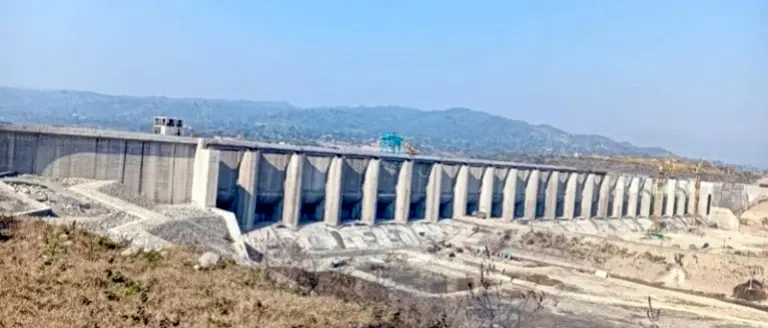
Srinagar: Excess water from the Ravi river will stop flowing into Pakistan soon. Javed Ahmed Rana, the water resources minister of
Jammu and Kashmir has said that the Shahpur Kandi dam on the Union Territory’s border with Punjab will be completed by March 31, following which all the water will be utilised for irrigation and power generation purposes by India.
Prime Minister Narendra Modi had announced a slew of punitive measures against Islamabad that included suspension of the Indus Waters Treaty (IWT) of 1960, after the terror attack in Pahalgam on April 22, 2025, which left 25 tourists and a local guide dead.
“Yes, excess water (from Ravi river) to Pakistan will be stopped. It has to be stopped,” Rana responded to a pointed query by a TV channel, as reported by Hindustan Times.
“Kathua and Samba districts are drought-hit areas; and this project, which is our priority, is being constructed for the Kandi area” he said.
The Prime Minister had speeded up the hydroelectric projects in Jammu region to ensure optimal use of river waters. The Shahpur Kandi barrage, a national project, was revised after four decades following his intervention.
India made steady progress on four ongoing hydel power projects in Jammu and Kashmir over the Chenab river, since the Pahalgam attack, and they are likely to be commissioned in 2027-28.
Under the IWT, brokered by the World Bank, six rivers of the In
dus system were divided between the two countries The eastern rivers (Ravi, Beas, Sutlej) were given to India and the western rivers (Indus, Jhelum, Chenab) were given to Pakistan, with India permitted limited, non-consumptive use of the latter.
The Shahpur Kandi project received approval on December 6, 2018, from a cabinet chaired by PM Modi. It received a central assistance of Rs 485.38 crore (for irrigation component). On completion of the project, an irrigation potential of 5,000 hectares of land in Punjab and 32,173 hectares in Jammu and Kashmir’s Kathua and Samba districts would be created.
Once completed in collaboration with Punjab, it would minimise the waste of water of the Ravi through the Madhopur Headworks that flowed downstream to Pakistan. Water being released to provide irrigation in 1.18 lakh hectares area in Punjab would be managed/regulated efficiently through this project.
Punjab would also be able to generate 206 MW of hydropower after completion of the project.
A bilateral agreement was signed between Punjab and J&K in 1979, as per which the construction of Ranjit Sagar Dam (Thein Dam) and Shahpur Kandi Dam was to be taken up by Punjab. The project was approved by the Planning Commission in 2001. A revised cost was approved by the Centre in 2009.
However, work could not progress on Shahpur Kandi much due to non-availability of funds on the part of the government of Punjab for the power component and later interstate issues with J&K. About 80 km of the Ravi canal and 492.5 km of distribution network in J&K constructed years ago had remained unutilised due to continuous delays in the completion of the barrage.
A series of meetings followed between J&K and Punjab, and with the Centre. Finally, an agreement was reached between Punjab and J&K states in Delhi in 2018.