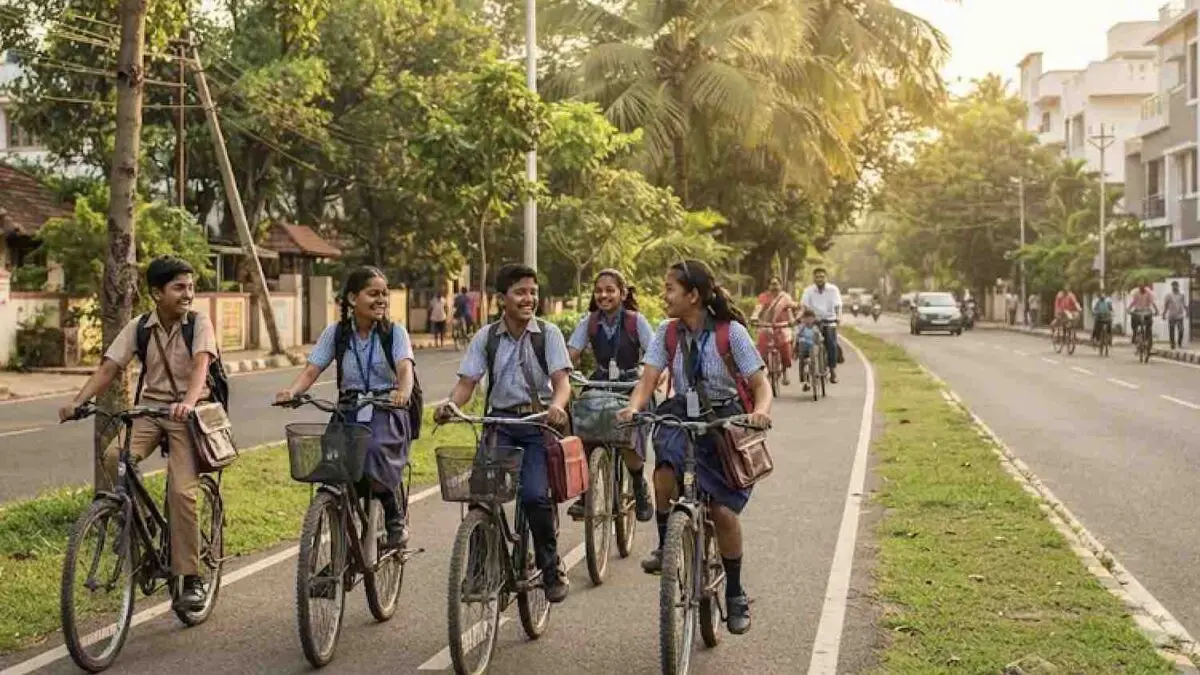
Many people in Bhubaneswar have fond memories of cycling and walking to school with friends and neighbours, in many instances forming lifelong friendships. As more children are driven to school in today’s world, that sense of community well-being can be lost to an increasing sense of isolation, in both children and parents.
Cycling to school doubles down on the benefits of physical activity for kids, offering them a chance to get some exercise before and after school in a way that is inherently social, thereby increasing their likelihood of forming close bonds with parents, peers, and neighbours.
Does every parent want to help their child get better grades in school? The answer may have less to do with studying longer and more to do with getting outside and moving. Research shows that regular physical activity can improve children’s brain function, memory, concentration, and academic performance, while also helping them stay out of the “obesity club.”
For children and teenagers, cycling opens up the world beyond the front door. Being able to cycle to school, meet friends, visit the park, or explore the neighbourhood gives young people a greater sense of independence and the freedom to move around on their own.
Compared to most European countries, children in the Netherlands enjoy higher degrees of independence and freedom, and Dutch teenagers cycle on average 6.2 km daily—more than any other age group.
Safe cycling infrastructure is not just about moving from A to B, or commuting faster; it is also about teaching independence to younger generations.
In Matsuyama (Japan), almost 90% of high school students cycle to school every day—higher than in cities like Amsterdam or Copenhagen. The Ehime prefecture supported this approach. In 2016, the governor formed a new bicycle culture association, with campaigns and events promoting cycling. For teenagers, the bicycle means independence. They travel safely and healthily without relying on parents.
The Netherlands was not always a cycling paradise. A series of protests by parents for safer streets in the 1970s often involved painting cycle lanes at night, staging die-ins at major junctions, blocking traffic, and vocally protesting across cities. In the Netherlands, cycle lanes did not appear out of nowhere; their creation was the result of years of intense advocacy and collaboration between institutions and civil society.
The latest advice comes from an international panel of experts who gathered in Copenhagen, Denmark, to conduct a comprehensive analysis of the benefits of exercise for school-age children. The panel of 24 researchers from eight countries determined that physical activity offers multiple and significant benefits for children’s cognitive development.
“Physical activity before, during and after school promotes scholastic performance in children and youth,” reads a statement released by the British Journal of Sports Medicine. “Physical activity and cardiorespiratory fitness are beneficial to brain structure, brain function and cognition in children and youth.”
But if our mayor, politicians, bureaucrats, civil society, media houses, schools, and more importantly, parents, still worry that time spent playing around on two wheels might get in the way of homework, and that children should instead be studying in the back of the car, don’t worry: science has you covered.
The researchers noted, “Time taken away from academic lessons in favour of physical activity has been shown to not come at the cost of scholastic performance in children and youth.”
So that settles it. If you’re hoping to raise a well-adjusted brainiac, all you need to do is buy your kid a bicycle and ask your government to ensure that the future youth of your city are provided with appropriate bicycle infrastructure, so your kids can move freely, on this World Children’s Day.
We also celebrated Children’s Day along with World Diabetes Day on November 14, a day that reminds us how we have slowly become trapped in a bad lifestyle and turned our society into the diabetes capital of the world. Today we see many people working out in the gym but unable to cycle or walk even five kilometres.
So, let’s bring the bicycle into our everyday lifestyle. The choice is simple: make friends with cycling, or join the obesity club and shed sweat inside the gym.
(Views expressed by the columnist are personal and do not necessarily reflect the opinion or policy of the news portal)