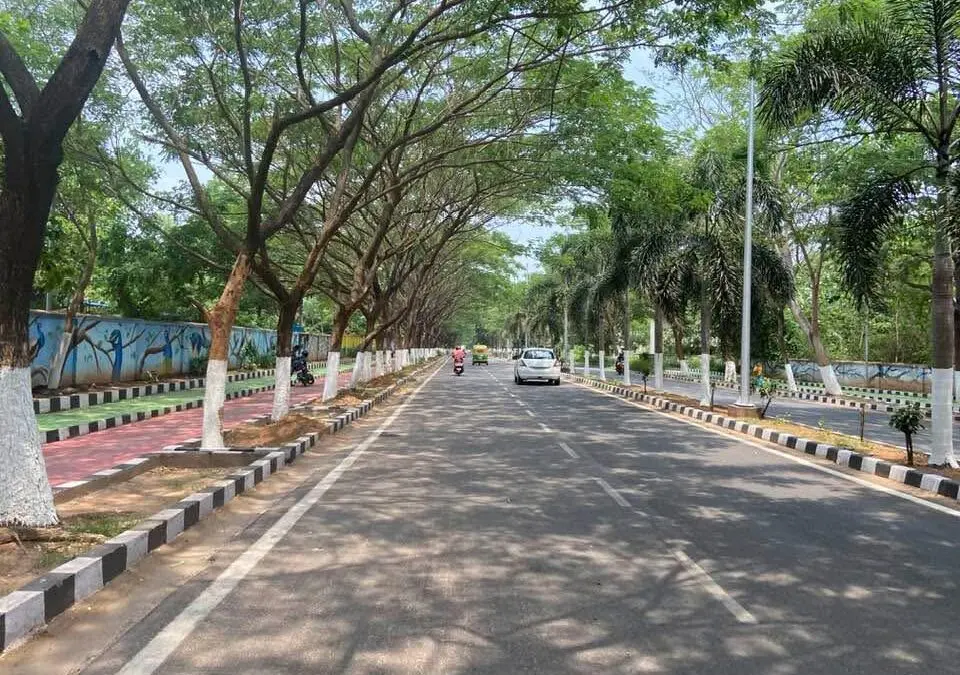
The pursuit of a world-class city has come at a steep cost for Bhubaneswar. What was once the Temple City is now noticeably warmer than it was just a couple of decades ago.
The large-scale felling of trees for road widening and parking, along with the replacement of natural water sponges by concrete, has disrupted the city’s natural cooling systems. Rejuvenating these lost green and blue assets is the most effective way to restore the city’s natural air conditioning rather than relying solely on energy-intensive artificial systems that only add to the warming.
While cycling through the city, one can clearly see how local conditions influence temperature. In some pockets, the heat feels intense, while in others, the soothing presence of trees and remaining water bodies is immediately noticeable. Though greatly diminished, these natural sponges and tree-lined avenues were once the pride of Bhubaneswar—offering not just beauty, but vital buffers for the city’s sustainability.Over the last couple of decades, summers have arrived earlier and lingered longer. Temperatures have soared across Odisha’s urban centres, including Bhubaneswar.
The city had emerged as one of the world’s hottest on 1 April 2021. In 2024, Bhubaneswar endured 17 consecutive days of 40°C and remained above 35°C for 270 days. Similar patterns have marked the past decade. Built-up areas have increased by 33%, while vegetation has declined by 17.8% and natural water sponges by a staggering 78% over four decades.
Even in 2025, the city did not record a single day of good air quality as per WHO standards. The number of rainy days has decreased, yet rainfall intensity has risen, while natural drainage channels have been converted into concrete drains. For those who can afford it, switching on the air conditioner offers immediate relief. However, this is not a sustainable long-term solution on a warming planet. Rising dependence on cooling systems drives massive increases in electricity demand, which in turn accelerates climate change and higher temperatures.But it doesn’t have to be this way.
Bhubaneswar can lead by embracing nature-based solutio
ns — actions defined by the International Union for Conservation of Nature (IUCN) as efforts to protect, sustainably manage, and restore ecosystems to address societal challenges while delivering human well-being and biodiversity benefits.
Like many cities, Bhubaneswar grapples with the urban heat island effect, where concrete and tarmac absorb and radiate heat long after sunset. The solution lies in leveraging the city’s existing green infrastructure — its rivers, canals, and natural streams. Transforming road verges and concretised drainage channels into vibrant green corridors can significantly reduce the heat island effect.
It is time for Bhubaneswar to move beyond planning on paper and commit to planting major roads as well as neighbourhood streets as green corridors, with special focus on areas that currently lack greenery. Such interventions have the potential to lower local temperatures by more than 2°C, offering a tangible difference that residents can feel.The green corridor approach demonstrates how smart urban planning can harness nature for multiple benefits.
Studies show that urban parks can reduce daytime ambient temperatures by about 1°C on average. Milan, which faced power outages due to extreme summer heat, is planning to plant three million trees by 2050 to combat the heat island effect and improve air quality. Green roofs, meanwhile, can cut building energy use by 10–15%, and in some cases reduce cooling loads by up to 66%.By drawing on such international examples, Bhubaneswar can show how nature-based solutions help both mitigate and adapt to climate change. Meeting the goals of the Paris Agreement will require cities to seriously deploy these measures. Without them, emissions from the cooling sector alone are projected to rise 90% by 2050 compared to 2017 levels
.As global temperatures rise, keeping cool is becoming a critical public health issue — one in which cities like Bhubaneswar are especially vulnerable. Thoughtful urban planning, including green roofs, green corridors, and better building design for passive cooling, must form a core part of the response. Nature-based solutions, however, are only one piece of the puzzle. Real progress will require coordinated action among governments, businesses, civil society, and international partners to reduce emissions across the board.
God gifted us Tribhubaneswar. It is our responsibility to make it Bhubaneswar once again.
The time to act is now — before we lose our biodiversity forever and can only remember it in museums and zoos. Let us join the coolest movement for the planet and help Bhubaneswar lead by example.
(The opinions expressed in this article are solely those of the author and do not necessarily reflect the official views or policies of news portal)