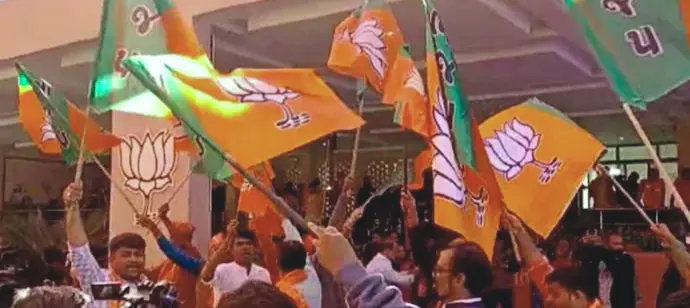
Ahmedabad: The BJP swept the local body elections in Gujarat like never before, winning all 15 municipal corporations and a majority of the municipalities, district panchayats and taluka panchayats.
While the Congress suffered a sharp collapse, AAP managed only scattered, symbolic gains. The results are being seen as the first major political signal ahead of the 2027 Assembly elections in the state.
Elections were held for 15 Municipal Corporations, 84 Municipalities, 34 District Panchayats and 260 Taluka Panchayats. Of the 10,050 total seats, 732 had already been won unopposed, while the remaining seats produced a decisive verdict.
The biggest surprise came from Surat, once projected as AAP’s laboratory in Gujarat politics. In 2021, AAP had stunned the state by winning 27 seats and emerging as the main opposition in the Surat Municipal Corporation.
The BJP won 115 seats this time, with the Congress managing just one, and AAP reduced to four.
The BJP also won 76 municipalities, while the Congress was restricted to just eight.
Rural Gujarat, once considered Congress territory, also tilted strongly towards the BJP. Out of 34 district panchayats, comprising 1,090 seats, the BJP won 568. The Congress managed only 77, while others took 30. In political terms, 33 out of the 34 district panchayats moved under BJP influence, a dramatic shift from past years when Congress had dominated rural belts.
In the 260 taluka bodies with 5,234 seats, the BJP won 2,397 seats, with the Congress managing 591, and others claiming 329.
In terms of control, the BJP captured 253 of the 269 taluka panchayats, leaving just seven for the Congress and AAP combined, as reported by The New Indian Express.
AAP managed one symbolic breakthrough amid the saffron surge. In Amreli district, the party captured Bagasara Taluka Panchayat for the first time in history. Though small in numbers, the victory gives AAP a talking point as it struggles to stay relevant after the collapse of its urban momentum.
The verdict has triggered deeper concerns for the Congress. Once the principal challenger in Gujarat, the party has trailed badly in urban seats and lost significant ground in rural institutions where it once relied on legacy networks. The results expose a widening gap between Congress rhetoric and booth-level strength.