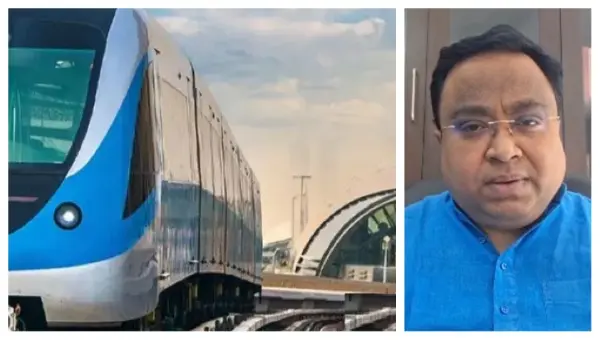
Bhubaneswar: Biju Janata Dal (BJD) Rajya Sabha member Sasmit Patra on Thursday appealed to Chief Minister Mohan Majhi to reconsider the state’s recent decision to scrap Bhubaneswar-Cuttack-Khurda-Puri Metro Rail project, citing the funding model of recently approved for Jaipur Metro Phase-2 by the Union Cabinet.
In a letter to the Chief Minister, Patra highlighted the Union Cabinet’s approval on April 8, 2026, of Jaipur Metro Phase-2—a 41-km North-South corridor with 36 stations at a total cost of approximately Rs 13,038 crore. The project will be executed through a 50:50 Centre-State Special Purpose Vehicle (SPV) under the Metro Rail Policy, 2017, with support from subordinate debt and external financing. “This sets a clear precedent: large metro projects are being implemented through structured Centre—State partnership,” he argued.
Patra further noted that Odisha Metro project, with an approved cost of Rs 6,255 crore for its initial 26-km Phase-1 covering 20 elevated stations from Biju Patnaik International Airport to Trisulia Square in Cuttack, with potential extensions toward Khurda and Puri, is less than half the scale of Jaipur’s Phase-2. “Originally planned as a 100% state-funded initiative, it could now be restructured with roughly Rs 3,100 crore each from the Centre and the state, plus the balance through Viability Gap Funding (VGF) or other structured financing,” he wrote.
“If Jaipur Metro Phase-2 of more than Rs. 13,000 crore supported by Union Government is viable, I am sure Odisha Metro (Puri-Khurda-Bhubaneswar-Cuttack) with half the cost of Jaipur Metro Phase-2 would find viability and policy-alignment,” he said,
-revive-paused-bhubaneswar-metro-rail-project/”>referencing his earlier letter to Union Housing and Urban Affairs Minister Manohar Lal Khattar on April 6, warning that discontinuing the project would undermine a vital mobility and economic lifeline for the state.
Earlier this month, the Odisha cabinet decided to terminate the project and the agreement with Delhi Metro Rail Corporation (DMRC) as the turnkey consultant, citing concerns over low ridership projections, feasibility issues, non-compliance aspects with the National Metro Rail Policy 2017, and potential cost escalations. The Bhubaneswar Metro Rail Corporation Limited (BMRCL) is being repurposed for broader sustainable urban mobility initiatives, with a shift in focus toward developing the Bhubaneswar-Cuttack-Puri-Paradip economic corridor.
Patra countered that the corridor along Puri-Khurda-Bhubaneswar-Cuttack would provide safer, faster, and more comfortable travel options for residents, improve access to education and jobs for students and youth, offer better mobility for senior citizens, boost tourism connectivity to key pilgrim and heritage sites like Puri, support small businesses, reduce traffic congestion, and stimulate overall economic growth.
Amid demand for revival of the project, Works Minister Prithiviraj Harichandan had earlier reiterated the state’s commitment to eventually introducing a metro system in the capital but made it clear that any progress would depend on a thorough feasibility assessment and the completion of a comprehensive mobility plan. He warned against hasty decisions driven by short-term political considerations, noting that proceeding under current conditions could result in annual losses ranging from Rs 1,000 to 2,000 crore. He also criticised the previous government’s handling of the initiative, describing the earlier agreement as a “faulty contract” with an unsuitable alignment. He pointed out that the prior government had advanced the project without securing central government involvement, unlike metro initiatives in other cities that typically operate under a Centre-State partnership model.