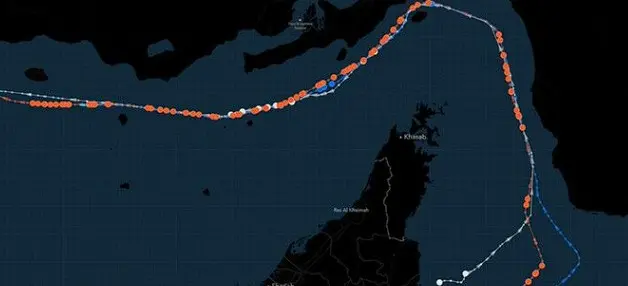
Dubai: Two vessels sanctioned by the US for Iran connections navigated the Strait of Hormuz into the Persian Gulf on Thursday via a possible novel route originating in the United Arab Emirates, on the third day of a US maritime blockade.
Industry stakeholders — shipowners, energy traders, and investors — are intently watching strait traffic to assess dominance by Tehran and Washington over this key global shipping artery. Few ships have passed since US launched the naval blockade, largely due to crews facing checks from both US and Iranian naval forces for secure transit, Bloomberg reported.
Unusual Island Route Eases Entry For Sanctioned Ships
Liquefied petroleum gas carrier, G Summer, entered the Persian Gulf by threading between Iran’s Larak and Qeshm islands on Wednesday afternoon, according to ship-tracking data. Broadcasting Chinese ownership and crew as a protective step, the empty tanker lists Iraq’s Khor Al Zubair as its destination.
The very-large crude carrier (VLCC) Hong Lu—blacklisted by Washington like G Summer for Iran ties — followed through the islands soon after. This two-million-barrel capacity ship, currently unloaded, is heading west off Iran’s coastline. It temporarily signaled Iraq’s Basrah port but now shows “waiting for orders.”
G Summer and Hong Lu docked off UAE’s Fujairah earlier this week, then took a northeast detour across the Gulf of Oman to Iran’s shore on Wednesday before pushing north into Hormuz—an atypical itinerary.
Other Vessels Follow Suit Amid Trickle of Traffic
Hours earlier, bulk carrier Rosalina mirrored the route, declaring a destination at an Iranian port with food cargo.
A small products tanker, Nobler, headed eastward out of the strait into the Gulf of Oman shortly later, skirting just south of Larak island en route to Sohar in Oman. It had been in the Persian Gulf since early February during the seven-week conflict.
Nobler’s exit came after two Iran-linked container ships, Golbon and Kashan, departed the Persian Gulf on Wednesday, sailing along Iran’s coast toward Pakistan.
The twin blockade hasn’t fully stemmed flows, passages have slowed to a drip, though. No loaded Iranian oil tankers exited Hormuz, threatening the conflict-era output of roughly 1.7 million barrels per day — possibly in an effort to avoid clashes. Jamming and transponder shutdowns could obscure some movements.
Conflicting Claims And Sharp Drop In Transits
US Central Command announced on Wednesday that “no vessels got through its blockade,” noting nine turned back toward Iran per US directives. Tehran, however, countered that “one of its own oil supertankers had broken the US blockade”. Iran did not name the vessel, but it could potentially be the empty US-sanctioned Alicia, which passed Larak inbound on Wednesday ahead of Hong Lu.
Ship‑tracking data compiled by Bloomberg show that 11 merchant vessels made the crossing on Tuesday, compared with a pre‑blockade weekend average of 16 — a level that is relatively high for the current phase of the conflict but still well below pre‑war daily averages of about 135.
Equasis database lists Hong Kong-based Seaport-Glory Marine Co. Ltd. as G Summer’s owner and manager; no contacts provided. Hong Lu’s details are absent, standard for dark-fleet operators.
Rosalina is owned by Pacific Dream Shipping, which shares a Monaco address with Sea World Management s.a.m. That company could not be reached for comment outside regular business hours.
Nobler is owned by Ruisheng Ship Management Ltd., which shares the same address as its China‑based manager, Qingdao Shengxiang Shipping Co.; an emailed request for comment went unanswered, the report added.