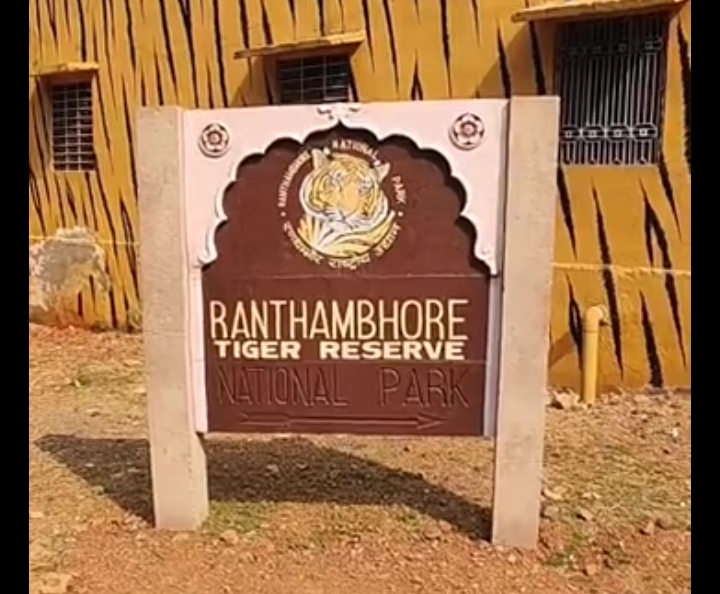
New Delhi: The Supreme Court has set up a three member committee to look into problems arising due to human activities within the Core Area/Critical Tiger Habitat (CTH) of Ranthambore Tiger Reserve (RTR).
The bench of Chief Justice of India B R Gavai, Justice Augustine George Masih and Justice A S Chandurkar was hearing applications bringing five major issues concerning RTR to the Court’s notice.
The first of these is regarding the gathering at the Trinetra Ganesha
Temple. This temple is situated inside the historic Ranthambore Fort that is about 5 km within the National
Park.
It has been stated in the applications that on Wednesdays alone, the number of pilgrims exceeds 10,000, on Sundays the figure touches nearly 6,000 and on
regular weekdays the footfall hovers around 2,500.
It was further claimed that the road leading from Ganesh Dham to Jogi Mahal Gate – a 6 km stretch – serves as the primary approach route to the Temple. This stretch, which lies entirely within the Core Area of the Tiger Reserve, witnesses an alarming number of private vehicles, including cars, taxis, motorcycles, and even pedestrians.
On certain days, upwards of 7,500 vehicles are illegally parked along the stretch, causing massive congestion and exposing high-density tiger zones to
intrusive human presence.
This influx of such large crowds results in multiple direct and indirect harms to the fragile ecosystem. Pilgrims cook food using firewood extracted illegally from the Tiger Reserve, dispose of plastic waste in large quantities, and cause severe anthropogenic disturbances to the wildlife, particularly tigers and other keystone species.
The second issue concerns Illegal mining activities within the Core Area/CTH of RTR. It was stated in the applications that nearly 150 ha of land
situated adjacent to Uliyana village within the CTH is affected by extensive illegal mining activities. The mining operations in Uliyana involve usage of heavy machinery and repeated movement of dumpers and tractor trolleys.
The applicants have also complained against illegal commercial constructions and encroachments inside RTR. Despite prohibition by the State of Rajasthan, illegal constructions have continued unabated. It was further stated that the Kachida Mataji Temple located inside the Tiger Reserve, has been continuously and unlawfully expanding over the years. Pilgrims visiting the temple regularly throw plastic waste inside the forest area.
It was also alleged that despite efforts and steps taken by the Ministry of Environment and Forest & Climate Change, the state of Rajasthan has not taken any steps for the protection and conservation of CTH of RTR. Due to non-declaration of ESZ of RTR – hotels,
motels, farm houses, residential colonies, commercial spaces – are
growing inside the CTH.
The fifth point pertains to conservation of historic structures within RTR. It has been highlighted that there are various historic structures situated inside RTR, such as Jogi Mahal, Battees Khamba, Bada Mahal, Ranthambhore Fort and a Jain Temple. It was submitted that the said historic structures are not being properly maintained.
“It will be appropriate that a committee of the following members is appointed which can address the concerns with regard to the issue in Ranthambore Tiger Reserve and recommend solutions in a phased manner: (i) The Collector, Sawai Madhopur, (ii) The Field Director, Ranthambore Tiger Reserve; and (iii) A member of the CEC. Needless to state that while addressing the issue pertaining to the maintenance and conservation of the Tiger Reserve, the Committee so constituted shall also take into consideration the interest of the devotees of the Trinetra Ganesha temple and give suggestions which would balance the interest of the Tiger Reserve as well as the devotees,” the Court said.
“The said Committee shall also give a hearing to the representatives of various stakeholders including the representatives of the Trust which manages the Trinetra Ganesha Temple. In order to protect the Ranthambore Tiger Reserve, we also deem it appropriate to direct the State of Rajasthan to take steps to ban mining in the core area of the Tiger Reserve. Needless to clarify that the ban on mining in the core area of Tiger Reserve shall scrupulously
be followed without permitting any interference from any of the stakeholders. The State of Rajasthan shall, accordingly, file an affidavit within a period of 6 weeks from today stating as to what steps it has taken for prohibiting mining in the core area of Ranthambore Tiger Reserve,” the Court further observed.