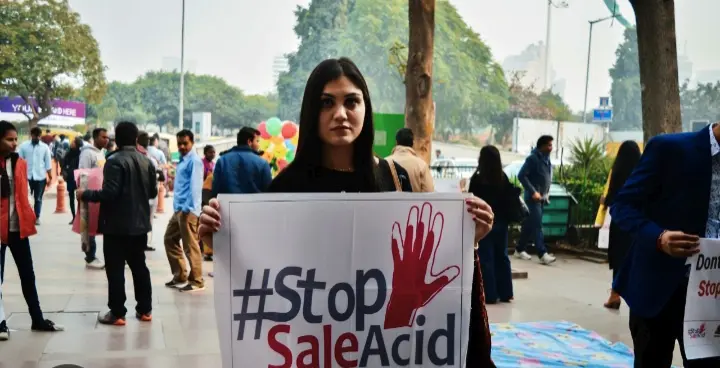
New Delhi: In a major move against acid attacks across the country, the Supreme Court has proposed a complete ban on the retail sale of acid by private individuals, including through online and door-delivery platforms, expressing concern that its “easy and largely unregulated availability” in the open market.
The bench of Chief Justice of India (CJI) Surya Kant, Justice Joymalya Bagchi and Justice V Mohana suggested that acid be sold for medical purposes only through pharmacies attached to government hospitals and upon obtaining prior written approval from the chief medical officer or civil surgeon concerned.
The court also proposed making buyers vicariously liable for any diversion or misuse of acid purchased by them, including misuse by another person, whether or not the buyer was aware of it, as reported by Deccan Herald.
The Court made its suggestion in a petition filed by Shaheen Malik. The Court had earlier asked the Centre to explain why a complete prohibition on retail sale of acid should not be imposed.
“The unfortunate persistence of acid attacks is a stark reminder that the regulatory safeguards put in place by this Court have not achieved their intended purpose,” the bench said, expressing concern over the inadequate implementation of its earlier directions.
It recalled its July 18, 2013 directions in Laxmi Vs Union of India in which the Court had passed directions to regulate the sale and distribution of acid.
Every permitted sale would have to be made through a prescribed form recording the buyer’s identity, address, contact details, quantity purchased and purpose of purchase under the proposed framework.
The acid would be used only for the stated purpose, the buyer would also have to declare.
The buyer’s immovable property could be obtained, which may be attached in accordance with law to meet the treatment expenses or compensation payable to victims in case of misuse, the bench further suggested.
The court impressed upon the Centre and state governments to consider these measures through appropriate legislative or rule-making interventions to put in place a comprehensive regulatory framework.
Pending the formulation of such a policy, it directed the Union government, states and Union Territories to strictly enforce its directions in the Laxmi case and the rules framed under the Poisons Act, 1919.
The National Legal Services Authority (NALSA) has also been entrusted with coordinating the implementation of a survivor-centric policy framework submitted by the intervenor NGO, NAVYA Centre for Justice and Social Change.
The framework envisages a standard operating procedure (SOP) for providing first aid to acid attack victims and a corresponding educational curriculum for schools and colleges.
The court also accepted suggestions for introducing educational material on acid attack prevention, emergency response and the rights of survivors in school and college curricula.
The proposed module would cover prevention of violence, consent, stalking and harassment; emergency first aid, including calling 112, continuous irrigation of the affected area with running water and urgent hospitalisation; legal rights, hospital obligations, legal aid and compensation; and the long-term medical and psychosocial rehabilitation of survivors.
It directed the Centre, through the Ministries of Education and Health and Family Welfare, to consider constituting an expert committee in consultation with NCERT, UGC, the National Medical Commission, NALSA, the National Commission for Women, state authorities, burn-care experts and survivor-led organisations.
The module should be introduced in a phased and age-appropriate manner, from middle school to higher education, in accordance with the National Curriculum Framework for School Education, 2023, and as determined by NCERT, the court said.
NALSA was directed to coordinate with the concerned authorities, oversee the development and implementation of the module and SOP, and submit compliance reports every three months.
The Centre has been asked to file an affidavit within two weeks detailing the steps taken. The Court posted the matter for further consideration on December 14.