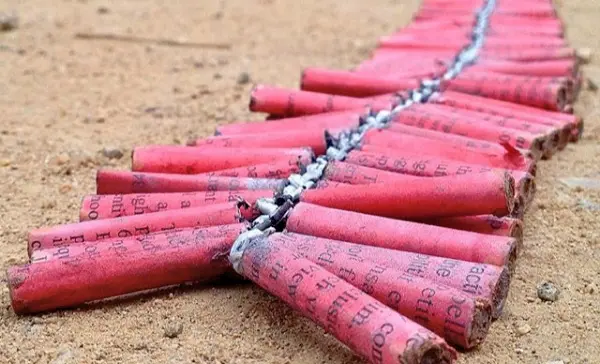
New Delhi: The Supreme Court, on Wednesday, refused to impose a total ban on firecrackers while saying that it would not allow them to be burst throughout the day.
The Court also permitted the use of “specified next generation joint green crackers”, popularly known as laris, while giving the Centre and expert bodies time till October 15 to complete their assessment of the impact of barium content in other green crackers on ambient air quality.
It would neither permit a blanket ban on firecrackers nor allow their unrestricted use for 24 hours, the bench of Justice M M Sundresh and Justice P B Varale said, stressing the need to strike a balance between environmental concerns and public sentiment.
“We will neither allow a total ban nor will we allow 24 hours bursting of crackers everywhere. A total ban will hurt certain sentiments and allowing 24 hours will have a huge impact on people, including old people, sick persons and children,” it observed, as reported by Hindustan Times.
The Supreme Court, in October 2025, allowed so-called green firecrackers – the first of any firecrackers to be allowed in years – to be burst during Diwali.
Wednesday’s order extends that relaxation nationwide and cleared joined crackers that remained banned even under the 2025 rules.
The Court accepted the Centre’s position, based on consultations with experts from the Council of Scientific and Industrial Research-National Environmental Engineering Research Institute (CSIR-NEERI), Petroleum and Explosives Safety Organisation (PESO) and Central Pollution Control Board (CPCB), that specified next-generation joint crackers, or “laris”, could be permitted subject to prescribed safeguards. Laris are strings of crackers fused to go off one after another.
The expert bodies were of the view that the new-generation joint crackers could be used as they recorded noise levels below 125 decibels additional solicitor general Aishwarya Bhati told the court.
This is significantly lower than conventional crackers which generate noise levels ranging between 140 and 160 decibels, besides the fact that they did not use barium in their compositions.
The experts, however, have prescribed conditions for manufacturers relating to the “shell number, shell size, and time between burst”, which will have to be adhered to for such crackers to qualify for use.
The Court had, earlier this month, asked the Centre to examine whether a limited exemption from the existing restrictions could be worked out ahead of the festive season.
The more contentious issue of barium-containing green crackers, however, remains open.
Open-ground tests were required to assess the actual impact of barium content on ambient air quality, Bhati told the Court. The Centre and the expert bodies were then given time till October 15 to complete the assessment.
The Supreme Court had, in 2018, imposed a blanket ban on crackers containing barium and barium salts after scientific studies by CSIR-NEERI indicated that their ignition released pollutants harmful to respiratory health. Barium salts, chiefly barium nitrate, help crackers burn more violently by supplying oxygen, and give fireworks their green colour.