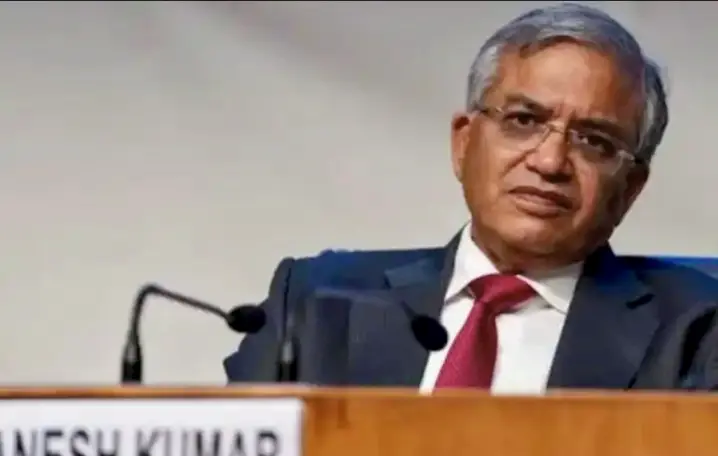
New Delhi: The Supreme Court, on Monday, refused to pass an interim order in pleas seeking the suspension of Chief Election Commissioner (CEC) Gyanesh Kumar.
It instead issued notice to the Election Commission of India (ECI), Kumar and the two other Election Commissioners on petitions challenging decisions allegedly taken unilaterally in the name of the poll panel.
The bench of Chief Justice of India Surya Kant, Justice Joymalya Bagchi and Justice V Mohana was hearing petitions questioning whether the CEC can exercise powers constitutionally and statutorily vested in the multi-member Election Commission without the concurrence of the other Election Commissioners.
Senior advocate Vikas Singh, appearing for the petitioners, said, “Every citizen of the country is feeling that Election Commission’s credibility is at stake.”
Singh argued for an interim order against Kumar and submitted: “ECs and ECI are more powerful today than any other constitutional authority.” Even the Prime Minister and judges do not have the protection that the Election Commission currently enjoys, he further said, as reported by News18.
“I am wanting an interim order today to suspend the Chief Election Commissioner,” Singh told the bench.
He also told the Court at one point that “If no interim order is passed the country will burn.”
The Court, however, did not grant the interim relief sought by the petitioners. The Election Commission would have an opportunity to respond to the allegations, it said.
“They will respond to us and we expect them to respond in a clear manner,” the Court said.
The bench also questioned the petitioners’ reliance on reports concerning alleged differences within the Election Commission. CJI Kant observed that the Election Commissioners are expected to take unanimous decisions and, where there is no unanimity, the matter has to be decided by majority.
“They are expected to make unanimous decisions. If there is no unanimity, it has to be by majority. Today, you are going only on a news report,” the CJI told Singh.
The petitions primarily challenge the alleged exercise of powers by Kumar individually on matters concerning the Election Commission, including decisions linked to the Special Intensive Revision (SIR) of electoral rolls. One of the key issues before the Court is whether decisions of the ECI, a multi-member constitutional body, can be taken or represented as decisions of the Commission without following the prescribed collective decision-making framework.
Now that the Court has ordered the issuance of notices to the ECI, CEC Gyanesh Kumar and the other two Election Commissioners, they will now be called upon to respond to the allegations raised in the petitions.