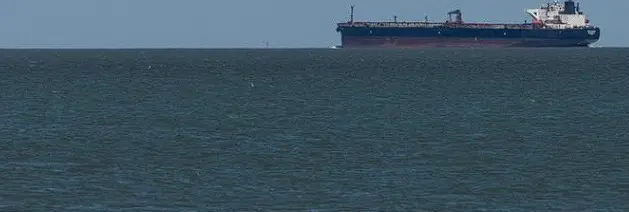
Singapore: A second supertanker under US sanctions has navigated into the Gulf via the Strait of Hormuz, challenging a US-imposed blockade aimed at vessels calling at Iranian ports, Reuters reported, quoting shipping data.
US President Donald Trump declared the blockade on Sunday, after weekend peace talks in Islamabad between Washington and Tehran collapsed without agreement. “10 vessels have been turned around and no ships have broken through since the start of the blockade on Monday,” the US Central Command said on X.
Yet Iran’s Fars News Agency said on Wednesday that “an Iranian supertanker subject to US sanctions crossed the strait towards Iran’s Imam Khomeini port despite the blockade.” Fars did not identify the tanker or provide additional voyage specifics.
Data from LSEG and Kpler confirmed the empty very large crude carrier (VLCC) RHN entered the Gulf on Wednesday. This massive vessel, with a capacity of 2 million barrels of oil, has no publicly confirmed destination, heightening uncertainty about its intentions amid the standoff.
Kpler data shows the RHN loaded Iranian crude multiple times in 2023-2024 from ports like Kharg Island, evading prior sanctions through ship-to-ship transfers.
The RHN’s entry came just a day after the US-sanctioned VLCC Alicia transited the strait, with Kpler data tracking it toward Iraq. The Alicia, also a 2-million-barrel-class tanker, has a history of hauling Iranian oil from Lavan Island in 2022 and 2024, often rerouting to shadow fleet operators in Asia. Kpler records indicate both tankers have loaded Iranian oil cargoes in the past few years, placing them firmly in the crosshairs of Washington’s sanctions regime.
Vessels intercepted include the US-sanctioned tanker Rich Starry, which ventured out of the Gulf on Tuesday only to return on Wednesday after being forced to turn back. The Rich Starry, a mid-sized tanker, carried sanctioned Iranian cargoes from Sirri Island as recently as early 2025, according to Kpler, before attempting the blockade run.
In a bid for negotiating leverage, the US has threatened secondary sanctions on third-party buyers of Iranian oil — just weeks after temporarily relaxing enforcement on certain Iran energy sanctions to encourage dialogue.
A source briefed by Tehran revealed Iran could propose “allowing ships to sail freely through the Omani side of the Strait of Hormuz without risk of attack” in ongoing US talks, contingent on a deal to forestall fresh conflict.
The blockade is projected to squeeze Iran’s crude exports significantly, though analysts note the OPEC member can sustain production at 3.5 million barrels per day (bpd) for several weeks by stockpiling in onshore facilities. Kpler data highlights Iran’s export resilience: 1.84 million bpd in March, 1.71 million bpd through April to date, compared to a 2025 average of 1.68 million bpd.