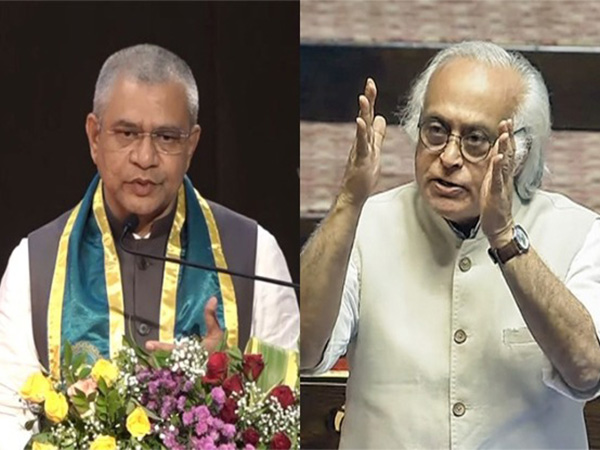
New Delhi: A war of words has erupted between Union Minister Ashwini Vaishnaw and senior Congress leader Jairam Ramesh after Prime Minister Narendra Modi claimed in his Independence Day speech that India’s semiconductor ambitions were “killed in the womb” 50–60 years ago. The remark has triggered a heated political and historical debate about when and why India’s semiconductor dream stalled — and who is to blame.
While Ramesh accused the Prime Minister of spreading falsehoods and rewriting history, Vaishnaw struck back, alleging that India’s early attempt at building a chip-making ecosystem was stifled by Congress-era red tape, indecision, and the infamous “license-permit raj.”
Modi’s Remark That Sparked It All
On Friday, Prime Minister Modi told the nation from the Red Fort: “File work on semiconductors began 50–60 years ago in our country. The idea of a semiconductor factory came forth 50–60 years ago… that idea… was killed in the womb 50–60 years ago. We lost 50–60 years.”
He went on to add that by the end of 2025, India would see the arrival of its first domestically manufactured chips, signalling a long-awaited breakthrough under the current administration’s India Semiconductor Mission.
Jairam Ramesh: PM A “Pathological Liar”
Responding swiftly, Congress general secretary in charge of communications, Jairam Ramesh, launched a scathing attack on social media: “One more example of what a pathological liar Mr Modi is. Semiconductors Complex Ltd established in Chandigarh started operations in 1983.”
Ramesh pointed to the existence of Semiconductors Complex Limited (SCL), a government-owned enterprise that was set up in the early 1980s and began operations in Chandigarh in 1983. He accused the Prime Minister of deliberately ignoring this legacy to suit a political narrative.
Ramesh also slammed the government’s semiconductor policy for allegedly discriminating against opposition-ruled states. He cited examples where companies were reportedly pressured to shift proposed chip plants from Telangana and Tamil Nadu to Gujarat and Andhra Pradesh in order to receive government approvals.
“Need anything more be said? The PM speaks of competition among states that will make India strong. But if the umpire is so blatantly biased, the competition becomes a farce,” he said.
Ashwini Vaishnaw Fires Back: “Policy Paralysis of Congress Killed the Opportunity”
Union Minister for Electronics and Information Technology Ashwini Vaishnaw responded by defending the Prime Minister’s statement and placing the blame for India’s delayed semiconductor journey squarely on the Congress party.
In a detailed rebuttal, Vaishnaw invoked a historical anecdote:
“Fairchild founder … came to India in 1964 … the license-permit raj of Congress … did not allow setting up a semiconductor plant … [policy paralysis] stalled such projects.”
What’s the Fairchild founder reference?
The Fairchild founder Vaishnaw referred to is Robert Noyce, widely regarded as one of the fathers of Silicon Valley and co-founder of both Fairchild Semiconductor and later Intel. According to Vaishnaw, Noyce explored the possibility of setting up a semiconductor plant in India in the 1960s, but was discouraged by the bureaucratic and restrictive economic environment under the Congress government.
Vaishnaw argued that this was a missed opportunity that could have changed the course of India’s tech history had it not been for policy paralysis.
A Modern-Day Chip War with Political Undercurrents
This sharp exchange between the two leaders has added a political dimension to what was until now largely a policy and economic narrative. The backdrop is India’s high-stakes semiconductor push, with the government approving four major chip manufacturing projects in states like Odisha, Andhra Pradesh, and Punjab — collectively involving over ₹4,600 crore in investments.
While the Modi government frames these developments as part of a transformational push to make India self-reliant in critical technologies, the opposition sees it as selective, politically biased, and dismissive of past achievements.
On one side, the Modi government argues that decades of missed opportunities under previous Congress regimes delayed India’s entry into high-tech sectors like semiconductors — a gap it now claims to be closing.
On the other, Congress leaders insist that India’s tech foundations were laid long ago and accuse the BJP of manipulating history for political credit while marginalising states ruled by opposition parties.
The semiconductor story is fast becoming one of the defining economic narratives of Modi’s third term. But as the Vaishnaw-Ramesh face-off shows, it’s also becoming a potent political weapon.