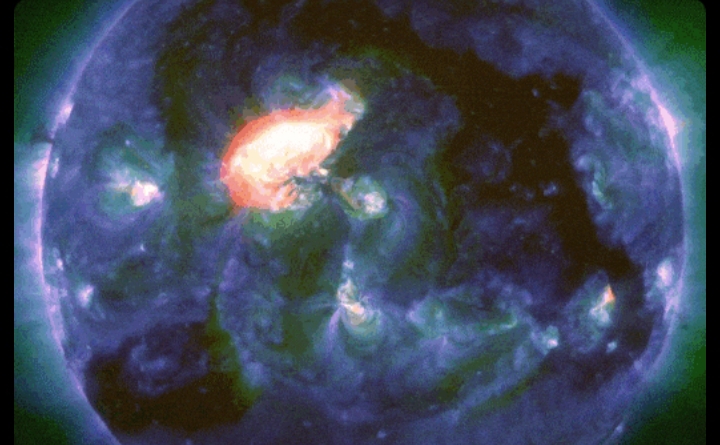
Washington: A powerful Coronal Mass Ejection (CME) from the Sun is headed towards the Earth. Upon impact, the CME is likely to trigger immediate geomagnetic disturbances. Severe (G4-class) geomagnetic storm conditions are possible at some places through Sunday and Monday, astronomers have said.
The storm’s severity will depend on the orientation and strength of the CME’s magnetic field as it interacts with Earth’s magnetosphere.
If conditions align, auroras could be visible at unusually low latitudes, offering a rare spectacle for skywatchers well beyond the polar regions. While this event is not expected to rival the legendary May 2024 storm, it could still be one of the most powerful of the current solar cycle.
In addition to auroras, severe geomagnetic storms can disrupt power grids, satellite operations, and GPS systems, prompting infrastructure operators to remain on alert.
According to reports, both NASA and National Oceanic and Atmospheric Administration (NOAA) models are in rare agreement that the solar storm will strike our planet on Sunday.
“The impact is expected to spark a severe (G4-class) geomagnetic storm, raising the possibility of dazzling auroras visible across much of Europe and numerous US states — potentially making it one of the most significant space weather events of Solar Cycle 25 if the storm reaches its predicted intensity. The source of this solar eruption is Sunspot 4100, which erupted in dramatic fashion on May Saturday,” a report states.
Earth-orbiting satellites detected an M8.2-class solar flare that lasted more than three hours, an unusually long and powerful event. While technically just shy of the X-class threshold, the flare’s slow, sustained energy release provided ample force to launch a massive CME from the Sun’s atmosphere.
Shortly after the flare, SOHO coronagraphs recorded a bright, fast-moving halo CME barrelling directly toward Earth.
Type II radio emissions from shock waves within the eruption indicate a velocity of about 1,938 km per second — among the fastest recorded this cycle.
As the world watches the skies, scientists and space weather forecasters emphasize that each event like this provides critical data for understanding and preparing for the Sun’s unpredictable moods.