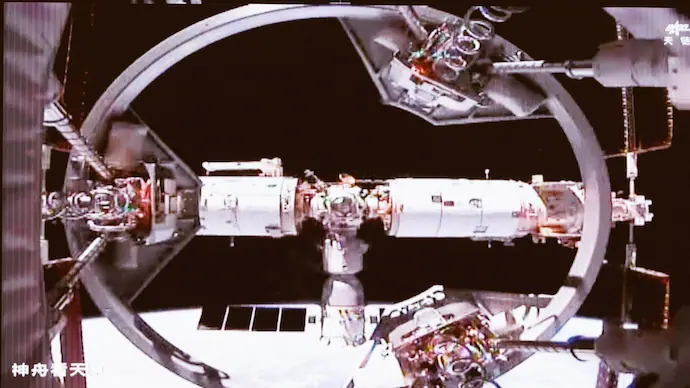
Beijing: China on Wednesday launched the Shenzhou-24 crewed spacecraft carrying three astronauts, including Pakistani national Muhammad Zeeshan Ali, who is set to become the first foreign astronaut to visit the Tiangong space station.
Mounted atop a Long March-2F carrier rocket, the spacecraft lifted off from the Jiuquan Satellite Launch Centre in northwest China. Space agency officials declared the launch a success minutes later.
The crew comprises mission commander and pilot Tang Hongbo, flight engineer Wu Yi, and Ali—marking the first time a foreign national has participated in China’s human spaceflight programme.
Shenzhou-24 is scheduled to dock with Tiangong in roughly three hours. While Chinese crews typically remain in orbit for six-month rotations, Ali will spend about a week aboard the station before returning to Earth on the Shenzhou-23 spacecraft.
According to Chinese officials, the Shenzhou-24 mission will complete an in-orbit crew handover with the outgoing Shenzhou-23 team, oversee routine station maintenance, conduct public outreach, and carry out payload tests. Over 90 scientific experiments and technology trials are scheduled across fields including space life sciences, medicine, materials science, microgravity fluid physics, combustion, and fundamental physics.
China’s orbital outpost
Beijing developed its own orbital outpost after being excluded from the International Space Station (ISS) amid US concerns over the People’s Liberation Army’s (PLA) role in China’s space programme.
Operational since 2022, Tiangong makes China the only nation currently running an independent space station. Although significantly smaller than the football-pitch-sized ISS—which has hosted over 3,000 experiments by international crews since 1998—Tiangong is positioned to become the primary orbital laboratory once NASA retires the ISS in early 2031 using a SpaceX-built deorbit vehicle over the South Pacific.