By Narendra Modi
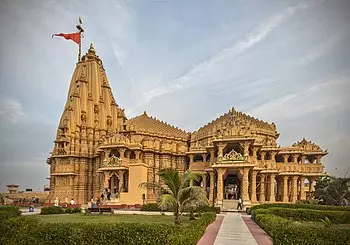
Somnath… hearing this word instils a sense of pride in our hearts and minds. It is the eternal proclamation of India’s soul. This majestic temple is situated on the western coast of India in Gujarat, at a place called Prabhas Patan. The Dwadasha Jyotirling Stotram mentions the 12 Jyotirlings across India. The Stotram begins with “सौराष्ट्रे सोमनाथं च..”, symbolising the civilisational and spiritual importance of Somnath as the first Jyotirling.
It is also said:
सोमलिङ्गं नरो दृष्ट्वा सर्वपापैः प्रमुच्यते।
लभते फलं मनोवाञ्छितं मृतः स्वर्गं समाश्रयेत्॥
It means — Just the sight of Somnath Shivling ensures that a person is freed of sins, achieves righteous desires and attains heaven after death.
Tragically, this very Somnath, which drew the reverence and prayers of millions, was attacked by foreign invaders whose agenda was demolition, not devotion.
The year 2026 is significant for the Somnath temple. It has been 1,000 years since the first attack on this great shrine. It was in January of 1026 that Mahmud of Ghazni attacked this temple, seeking to destroy a great symbol of faith and civilisation, through a violent and barbaric invasion.
Yet, one thousand years later, the temple stands as glorious as ever because of numerous efforts to restore Somnath’s grandeur. One such milestone completes 75 years in 2026. It was during a ceremony on 11th May, 1951, in the presence of the then President of India Dr Rajendra Prasad, that the restored temple opened its doors to devotees.
The first invasion of Somnath in 1026, the cruelty that was unleashed upon the people of the town and the devastation inflicted upon the shrine have been documented in great detail in various historical accounts. When you read them, the heart trembles. Each line carries the weight of grief, cruelty and a sorrow that refuses to fade with time.
Imagine the impact it had on Bharat and the morale of the people. After all, Somnath had great spiritual significance. It was also on the coast, giving strength to a society with great economic prowess, whose sea traders and seafarers carried tales of its grandeur far and wide.
Yet, I am proud to state unequivocally that the story of Somnath, a thousand years after the first attack, is not defined by destruction. It is defined by the unbreakable courage of crores of children of Bharat Mata.
The medieval barbarism that began a thousand years ago went on to ‘inspire’ others to repeatedly attack Somnath. It was the start of an attempt to enslave our people and culture. But, each time the temple was attacked, we also had great men and women who stood up to defend it and even made the ultimate sacrifice. And every single time, generation after generation, the people of our great civilisation picked themselves up, rebuilt and rejuvenated the temple. It is our privilege to have been nurtured by the same soil that has nurtured greats like Ahilyabai Holkar, who made a noble attempt to ensure devotees can pray at Somnath.
In the 1890s, Swami Vivekananda visited Somnath, an experience that moved him. He expressed his feelings during a lecture in Chennai in 1897 when he said, “Some of these old temples of Southern India and those like Somnath of Gujarat will teach you volumes of wisdom, will give you a keener insight into the history of the race than any amount of books. Mark how these temples bear the marks of a hundred attacks and a hundred regenerations, continually destroyed and continually springing up out of the ruins, rejuvenated and strong as ever! That is the national mind
, that is the national life-current. Follow it and it leads to glory. Give it up and you die; death will be the only result, annihilation, the only effect, the moment you step beyond that life current.”
The sacred duty of rebuilding the Somnath Temple after independence came to the able hands of Sardar Vallabhbhai Patel. A visit during Diwali time in 1947 moved him so much that he announced that the Temple will be rebuilt there. Finally, on May 11th 1951, a grand Temple in Somnath opened its doors to devotees and Dr. Rajendra Prasad was present there. The great Sardar Sahib was not alive to see this historic day, but the fulfilment of his dream stood tall before the nation. The then Prime Minister, Pandit Jawaharlal Nehru, was not too enthused with this development. He did not want the Honourable President as well as Ministers to associate with this special event. He said that this event created a bad impression of India. But Dr. Rajendra Prasad stood firm and the rest is history. No mention of Somnath is complete without recalling the efforts of KM Munshi, who supported Sardar Patel very effectively. His works on Somnath, including the book, ‘Somanatha: The Shrine Eternal’, are extremely informative and educative.
Indeed, as the title of Munshi Ji’s book conveys, we are a civilisation that carries a sense of conviction about the eternity of spirit and of ideas. We firmly believe that that which is eternal is indestructible, as outlined in the famous Gita verse “नैनं छिन्दन्ति शस्त्राणि…”. There can be no better example of our civilisation’s indomitable spirit than Somnath, which stands gloriously, overcoming odds and struggles.
It is this same spirit that is visible in our nation, one of the brightest spots of global growth, having overcome centuries of invasions and colonial loot. It is our value systems and the determination of our people that have made India the centre of global attention today. The world is seeing India with hope and optimism. They want to invest in our innovative youngsters. Our art, culture, music and several festivals are going global. Yoga and Ayurveda are making a worldwide impact, boosting healthy living. Solutions to some of the most pressing global challenges are coming from India.
Since time immemorial, Somnath has brought together people from different walks of life. Centuries ago, Kalikal Sarvagna Hemchandracharya, a respected Jain monk, came to Somnath. It is said that after praying there, he recited a verse, “भवबीजाङ्कुरजनना रागाद्याः क्षयमुपगता यस्य।”. It means – Salutations to That One in whom the seeds of worldly becoming are destroyed, in whom passion and all afflictions have withered away.” Today, Somnath holds the same ability to awaken something profound within the mind and soul.
A thousand years after the first attack in 1026, the sea at Somnath still roars with the same intensity as it did back then. The waves that wash the shores of Somnath tell a story. No matter what, just like the waves, it kept rising again and again.
The aggressors of the past are now dust in the wind, their names synonymous with destruction. They are footnotes in the annals of history, while Somnath stands bright, radiating far beyond the horizon, reminding us of the eternal spirit that remained undiminished by the attack of 1026. Somnath is a song of hope that tells us that while hate and fanaticism may have the power to destroy for a moment, faith and conviction in the power of goodness have the power to create for eternity.
If the Somnath Temple, which was attacked a thousand years ago and faced continuous attacks thereon, could rise again and again, then we can surely restore our great nation to the glory it embodied a thousand years ago before the invasions. With the blessings of Shree Somnath Mahadev, we move forward with a renewed resolve to build a Viksit Bharat, where civilisational wisdom guides us to work for the welfare of the whole world.
Jai Somnath!
(Narendra Modi is the Prime Minister of India and is also the Chairman of the Shree Somnath Trust)