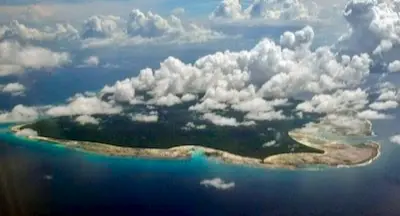
New Delhi: Is the Congress peddling China’s narrative by opposing the Great Nicobar Island project?
A day after Congress leader Sonia Gandhi’s article, calling the project a misadventure that tramples on tribal rights and makes a mockery of legal and deliberative processes, appeared in a national daily, Anil Antony, son of former Congress leader and defence minister A K Antony, slammed her for it.
In the article, Sonia has spoken on the alleged injustices being inflicted on the Nicobarese people. Her views got the backing from her son and Congress MP Rahul Gandhi.
Antony has pointed out that development of strategic infrastructure in Great Nicobar started during the UPA’s time. The naval air station INS Baaz was commissioned at Campbell Bay in Great Nicobar on July 31, 2012, when Sonia Gandhi was the UPA chairperson, he said.
“Over a decade later, on what basis, and on whose behalf, do you, your family, and your party – the Congress – now consider a project of such vital national security importance to have been a misadventure,” Antony, a national secretary of the BJP, has asked.
Meanwhile, Ashok Singhal, a minister in the Assam government has said that the Congress has a history of opposing projects of national importance. “If the Congress opposes any project, the nation should rest assured that the project is in the country’s interest,” he said.
The Great Nicobar Island is located barely 160 km from the Malacca Strait, considered one of the world’s most important maritime choke points. The island is at the western entrance of this narrow passage that handles nearly 40% of global trade and more than 80% of Chinas oil imports. This makes the Malacca Strait the most delicate energy and trade lifeline of Asia.
It goes without saying that a major base at Great Nicobar would provide India unmatched leverage for naval power projection, maritime surveillance, and Indo-Pacific security operations. It would also give New Delhi a decisive edge in times of geopolitical tension.
The Greater Nicobar project involves an investment of nearly Rs 72,000 crore and seeks to transform the island into a strategic and economic hub.
It involves the setting up of a deep-draft container transshipment port at Galathea Bay, a dual-use greenfield international airport for both civilian and military use, power plants and renewable energy systems, planned urban townships and logistics hubs and tourism and industrial zones to attract investment.
India spends millions of dollars in foreign exchange every year to use foreign ports like Singapore and Colombo for cargo transshipment. Currently, over 75% of Indias transshipped cargo is handled overseas. The Great Nicobar Project could position India as a maritime powerhouse and a regional shipping hub.
India is also upgrading its Andaman and Nicobar Command (ANC) by expanding INS Baaz (Campbell Bay) and INS Kohassa (Shibpur) to accommodate fighter jets and long-range surveillance aircraft, building new jetties, logistics hubs, and forward operating bases for the Navy and increasing surveillance over critical sea lanes with P-8I aircraft and UAVs.
These developments are crucial for India, given the Chinese military’s growing presence in the Indian Ocean Region.
According to defence experts, the Great Nicobar project is more than just an infrastructure initiative. It is a strategic masterstroke, combining economic development with military deterrence that would help position India as a pivotal player in the Indo-Pacific balance of power.