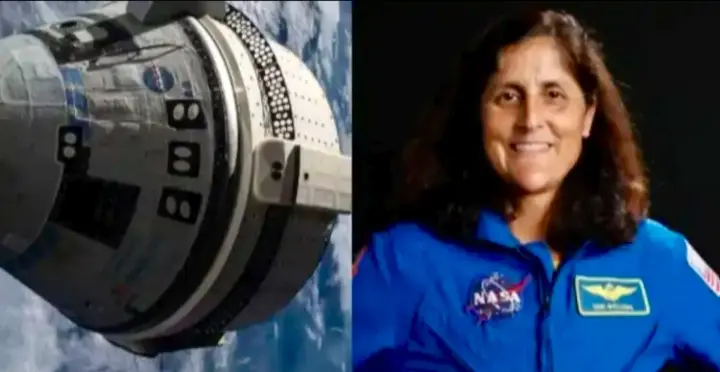
Houston: NASA has declared that the Boeing CST-100 Starliner Crewed Flight Test that left astronauts Sunita Williams and Butch Wilmore stranded at the International Space Station (ISS) for months was a “Type A mishap”.
The space agency released the findings of its Program Investigation Team, which acknowledged failures in both engineering and leadership.
There were technical flaws, communication breakdowns and “unprofessional conduct” during the high-stakes test mission, the report stated.
The spacecraft’s recurring issues and the need for transparency and accountability to address the issue have been highlighted by NASA administrator Jared Isaacman.
“The Boeing Starliner spacecraft has faced challenges throughout its uncrewed and most recent crewed missions. While Boeing built Starliner, NASA accepted it and launched two astronauts to space. The technical difficulties encountered during docking with the International Space Station were very apparent. To undertake missions that change the world, we must be transparent about both our successes and our shortcomings. We have to own our mistakes and ensure they never happen again,” he said.
Isaacman also admitted broader programmatic pressures may have influenced operational decisions, as reported by Republic TV.
“Beyond technical issues, it is clear that NASA permitted overarching programmatic objectives of having two providers capable of transporting astronauts to and from orbit influence engineering and operational decisions, especially during and immediately after the mission. We are correcting those mistakes,’ he briefed.
“Today, we are formally declaring a Type A mishap and ensuring leadership accountability so situation
s like this never reoccur. We look forward to working with Boeing as both organizations implement corrective actions and return Starliner to flight only when ready,” Isaacman added.
A Type A mishap falls in NASA’s highest level of investigation category.
In a letter to NASA employees posted on X, Isaacman wrote that the investigation uncovered deeper organizational concerns.
“Starliner has design and engineering deficiencies that must be corrected, but the most troubling failure revealed by this investigation is not hardware,” he wrote.
“It is decision making and leadership that, if left unchecked, could create a culture incompatible with human spaceflight,” Isaacman added.
Breakdowns in communication and leadership accountability during critical phases of the mission have been highlighted in the report’s cultural and organizational section.
Starliner launched on June 5, 2024, on its first crewed test flight to the ISS. The mission was initially planned to last between eight and fourteen days. However, propulsion system anomalies were detected while the spacecraft was in orbit. Five maneuvering thrusters failed roughly 24 hours into flight as Starliner approached the ISS for autonomous docking, forcing the crew to manually interve.
The mission was ultimately extended to 93 days while NASA reviewed flight data and conducted ground testing at White Sands Test Facility. NASA later opted to return Starliner to Earth without astronauts Butch Wilmore and Sunita Williams.
The spacecraft landed at White Sands Space Harbor in September 2024. Wilmore and Williams later returned safely aboard SpaceX’s Crew-9 mission in March 2025.
In February 2025, NASA chartered an independent Program Investigation Team to examine technical, organizational and cultural contributors to the mission’s problems.
NASA and Boeing have been working together since Starliner’s return to address identified deficiencies. According to the agency, technical root cause investigations are still ongoing.
Starliner will return to flight only after corrective actions are fully implemented, NASA said.