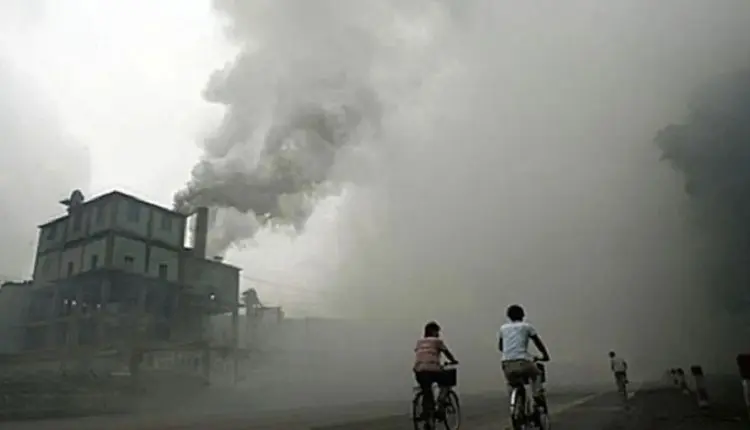
Baripada: Odisha has recently drawn attention for rising air pollution, with Baripada in Mayurbhanj district featuring in the infamous list of urban centres with very poor air quality.
The district administration has now introduced a series of strict measures to halt further decline in air quality to tackle the issue. This intervention follows the inclusion of Baripada, alongside Balasore and Talcher, in the list of most polluted towns in India with high Air Quality Index (AQI) in recent weeks. The development took residents by surprise, particularly because Baripada lies close to the Similipal Biosphere Reserve with an area of 4,000 square kilometres, is surrounded by lush greenery and has negligible industrial activity.
With the AQI crossing 300 multiple times over the past fortnight, the administration has moved decisively. Collector Hema Kanta Say invoked Section 163 of the Bharatiya Nagarik Suraksha Sanhita (BNSS) on Tuesday to enforce immediate prohibitory and regulatory measures across the town.
Acknowledging the grave risks posed to public health by worsening air quality and rising particulate matter, a set of guidelines have been issued by the Mayurbhanj District administration. According to the notification issued on January 6, these restrictive measures will remain in force for the next seven days. Locals have welcomed this move and Odias hope such affirmative action must be replicated in other districts where AQI readings are in hazardous levels. The following directives have been issued to curb air pollution:
1. All construction activitie
s—including road works, building projects, strengthening, and widening—must incorporate appropriate pollution-prevention measures.
2. Construction and demolition debris shall be disposed of strictly in accordance with the Construction and Demolition Waste Rules, 2016.
3. Demolition and earthwork operations must be undertaken with adequate dust-suppression provisions.
4. Urban Local Bodies (ULBs), the National Highways Authority of India (NHAI), and other executing agencies shall ensure water sprinkling on major roads and construction stretches at intervals not exceeding three hours to control road dust.
5. The Project Director, NHAI, and other executing agencies must carry out regular water sprinkling at under-construction sites across the district.
6. Wet drilling and controlled blasting for mineral extraction, road widening, and strengthening shall be enforced by the Mining Officer, PD NHAI, or other relevant agencies.
7. All ULBs in the district must promptly clean roads and remove accumulated dust.
8. Open burning of waste, coal burning in roadside eateries (dhabas), and any form of open fire are strictly prohibited.
9. The Chief District Agriculture Officer shall ensure a complete ban on stubble burning and disposal of crop residues in agricultural fields.
10. The bursting of firecrackers within the district is restricted.
11. Vehicles transporting construction materials such as fly ash, sand, or crusher dust must be covered with tarpaulin while plying on national highways, state highways, and city roads.
12. Brick kiln units may operate only with valid authorization from the competent authority.
13. All crusher units must install and maintain green fencing, wind-breaking walls, dust-suppression systems, and IP cameras.
14. Citizens are encouraged to adopt sustainable modes of transport, including public transport,
15. Unnecessary or excessive construction activities contributing to dust pollution must be avoided.