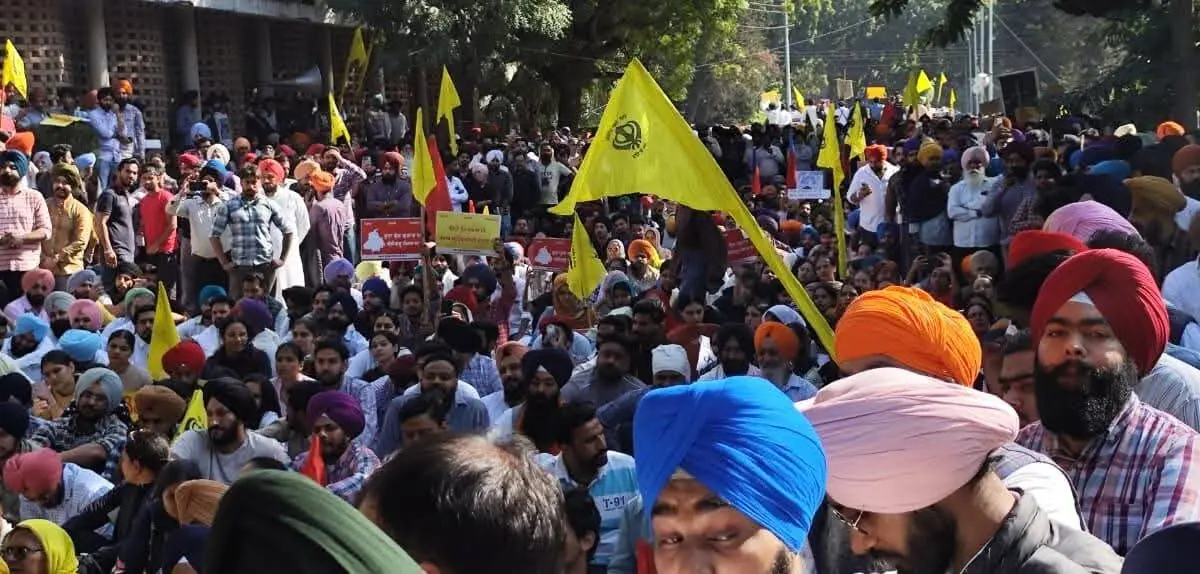
Chandigarh: Student unrest at Panjab University entered its second week as students pressed ahead with a protest demanding fresh elections for the university’s highest decision-making body, even after the Ministry of Education (MoE) withdrew a controversial notification to restructure its governing bodies.
What triggered the protest
On 28 October 2025, the ministry issued a notification that would have dramatically slimmed the size of the university’s Senate and transformed the Syndicate into a mostly nominated body, reducing elected member representation and scrapping graduate-constituency elections.
The move sparked intense opposition from student groups, teachers, political parties in Punjab and the Chandigarh Union Territory, and various farm and civil-society organisations, who argued that the change would undermine the university’s democratic functioning and the state’s stake in its governance.
Facing mounting pressure, the ministry on 7 November announced the withdrawal of the 28 October notification and froze the proposed structural changes pending further consultation.
Why protests continue
Despite the rollback, student leaders under the banner of the “Panjab University Bachao Morcha” declared the agitation will persist until fresh elections are formally scheduled for the Senate’s full complement of seats.
Their demands are clear:
Immediate announcement of election dates for all student, faculty and graduate-constituency Senate seats.
Guarantee of the university’s elected governance processes remaining intact, without pending structural changes that could dilute representation.
The students argue that the rollback, while welcome, does not automatically restore the electoral machinery or the timeline — nor does it reassure them that the governance changes will not be revived later. As one protester put it: “We will not pack up until the dates are fixed. The structure may have been withdrawn, but the implementation is yet to start.”
Campus atmosphere and escalation
On Monday, 10 November 2025, a large demonstration was held on campus, amid heavy police deployment. According to media reports, around two-thousand personnel were posted at entry points and checkpoints on highways leading into Chandigarh to intercept incoming protesters from Punjab.
A minor clash occurred when some protesters forced entry through the university’s gate-2 after others were turned away. The event triggered traffic congestion on the Zirakpur–Chandigarh highway and heightened tensions around the campus.
Meanwhile, the university administration issued orders restricting entry of non-university-ID bearers and suspended visitor access to guest-houses on campus, which students claim is an attempt to isolate and intimidate their movement.
Political reactions
The protest has drawn wide political resonance across Punjab. The state’s ruling party, the Aam Aadmi Party (AAP), labelled the proposed changes “unconstitutional” and pledged to approach the Punjab & Haryana High Court to challenge the Centre’s notification.
Senior opposition figures have portrayed the issue as a stand against the centralisation of educational institutions and Punjab’s diminishing control over its own academic heritage. For them, the university’s governance became a symbol of the state’s cultural and academic identity.
What happens next
The university’s Vice-Chancellor, Prof. Renu Vig, stated that the process for holding the Senate elections has been set in motion in line with the ministry’s November 7 notification, and that communication will soon be made to the Chancellor for necessary approvals, after which the voters’ list will be prepared.
However, student leaders remain unconvinced, demanding a firm election schedule and rejecting any proposed timeline that does not cover “all 91” seats, as previously constituted.