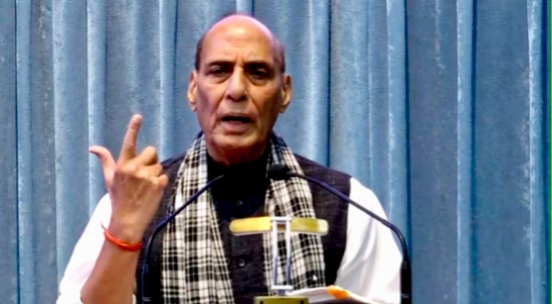
New Delhi: All important installations across the country will be provided complete aerial security under the proposed Sudarshan Chakra air defence system within the next 10 years, defence minister Rajnath Singh said on Saturday.
In an address at the NDTV Defence Summit, Singh said the air defence shield will comprise both defensive and offensive elements to deal with any enemy threats.
“As we saw during Operation Sindoor, the importance of air defence capability in today’s wars has increased to a great extent. In such a scenario, the Sudarshan Chakra mission will certainly prove to be a game changer,” he said.
In his Independence Day speech, Prime Minister Narendra Modi had announced the ambitious air defence project. The announcement came days after Pakistan Army Chief Asim Munir hinted at targeting Indian assets along the border in case of any future military confrontation between the two countries.
India’s defence architecture should not be dependent on any uncertain “foreign interference”, and it should be based on its own capabilities, the defence minister added.
Shifting geopolitics has made it clear that external dependency in the field of defence is no longer an option, he said, noting that: “In the current situation, self-reliance is essential for both our economy and our security.”
“Today, the defence sector is not only the foundation of national security but has also become a pillar in strengthening our economy and securing its future. It is not just about the safety of people, the protection of land, or the defence of borders, but it is also becoming a responsible sector for the protection and security of our entire economy,” Singh said.
“In the defence sector, self-reliance is not an issue of protectionism at all; rather, it is an issue of sovereignty. It is an issue of national autonomy. It is an issue of self-confidence,” he said.
Singh said that all Indian warships will be manufactured in India, reinforcing the Modi government’s push towards Aatmanirbharta. He noted that nearly 75 per cent of the new warships were designed locally, a development he said would significantly bolster India’s strategic autonomy.
The statement comes days after the commissioning of two indigenously-built Nilgiri-class stealth frigates, INS Himgiri and INS Udaygiri. Currently, there are no Indian Navy warships being built outside the country.
These advanced warships feature significant upgrades in weapon and sensor systems and are equipped to undertake a wide spectrum of maritime operations.
The minister said that the entire world had witnessed India’s growing defence capabilities during Operation Sindoor.
“The way our forces, with indigenous equipment, carried out precise strikes on their targets shows no mission can succeed without a vision, long-term preparation, and coordination,” he said.
He stressed that the operation was not just a short-term conflict but a reflection of long-term strategy.
“Operation Sindoor may seem like a war that lasted just a few days, and a story of India’s victory and Pakistan’s defeat, but behind it lay years of strategic preparation and a long role of defence preparedness,” Singh said.
Highlighting the importance of the defence sector in earning valuable foreign exchange, the defence minister said: “In 2014, our defence export was less than Rs 700 crore. Today, it has increased to nearly Rs 24,000 crore, reaching a record level. This shows that India is no longer just a buyer; it is becoming an exporter,” he said.
Singh also spoke on the ongoing tariff tensions with the US and a possible easing of ties with China. “There are no permanent friends or enemies, only permanent interests,” he said.