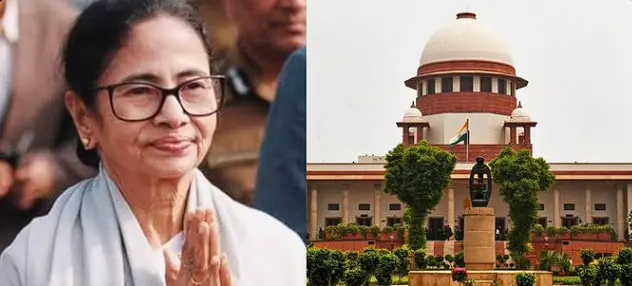
New Delhi: The Supreme Court has agreed to take up former West Bengal chief minister Mamata Banerjee’s petition against the Election Commission’s order freezing the Trinamool Congress name and its “Flowers and Grass” symbol on an urgent basis.
On Monday, a bench headed by Chief Justice of India Surya Kant said it would try to list the case within the week after senior advocate Kapil Sibal, appearing for Banerjee, pressed for an early hearing. Sibal told the court the poll panel had acted even while the internal dispute over party control was still being examined.
“Something extraordinary has happened. The notice was issued in June and we filed our reply in July. While all this is on, the symbol has been frozen. What is going on?” Sibal told the bench while seeking an early listing of Banerjee’s plea.
The CJI, however, said both sides would get a chance to argue their points when the matter is taken up. “Whenever the matter is listed, please argue these points at the time. Both sides will have something to say,” said the CJI. When Sibal sought an early hearing, the CJI said: “We will try and list it in this week itself.”
Banerjee moved the top court on September 18, hours after the Election Commission passed an interim order on September 17 freezing the original party identity for the coming by-elections and allotting separate names and symbols to the two rival groups.
Under the order, Banerjee’s faction has been named “Mamata All India Trinamool Congress” and given the “Football Player” symbol. The breakaway camp has been recognised as “Democratic Trinamool Congress” and allotted the “Envelope” symbol. These arrangements will apply to the upcoming bypolls, including contests in Nandigram and Rejinagar in West Bengal.
The Election Commission’s September 17 order came after both camps claimed control over the party name, symbol and organisational structure. The poll body said there were two rival groups — one led by Banerjee and the other by the opposing faction — and that the dispute required a substantive determination under Paragraph 15 of the Election Symbols (Reservation and Allotment) Order, 1968.
Banerjee’s petition challenges this interim freeze on the party’s name and symbol. Her plea names the Election Commission and the rival faction as respondents, as reported by Hindustan Times.
The trouble inside the Trinamool Congress started after the party lost the Bengal Assembly election, ending its 15-year run in power and triggering a fight over who really leads the outfit. Mamata Banerjee’s camp struck first, expelling two of its 78 MLAs — Ritabrata Banerjee and Sandipan Saha.
Soon after, about 57 legislators left Mamata’s side and backed Ritabrata, making him the Assembly’s Leader of the Opposition. This rebel bloc then claimed it was the true TMC and asked for full control of the party. It demanded the TMC’s name, its famous “flowers and grass” symbol, and the right to run the organisation.
At the Centre, 20 rebel TMC MPs joined the small Nationalist Citizens Party of India and sided with the BJP-led NDA. In the Bengal Assembly, Speaker Rathindra Nath Bose, on June 3, treated 58 rebel MLAs as the main opposition, naming Ritabrata Banerjee LoP and Sandipan Saha deputy LoP. This came a month after the BJP won 207 of 294 seats, pushing the TMC down to 80.
The split also weakened the TMC in the Rajya Sabha. Mamata’s group was left with just nine members after three MPs — Sukhendu Sekhar Roy, Sushmita Dev and Prakash Chik Baraik — quit in June, joined the BJP, and were re-elected on July 24. Another TMC Rajya Sabha member, actor Koel Mallick, also resigned, cutting the party’s strength further.
In the Rajya Sabha, the Mamata Banerjee-led TMC was left with nine members after Sukhendu Sekhar Roy, Sushmita Dev and Prakash Chik Baraik resigned in June, joined the BJP, and were re-elected to the Upper House on July 24. A fourth TMC Rajya Sabha member, actor Koel Mallick, also resigned from the House.