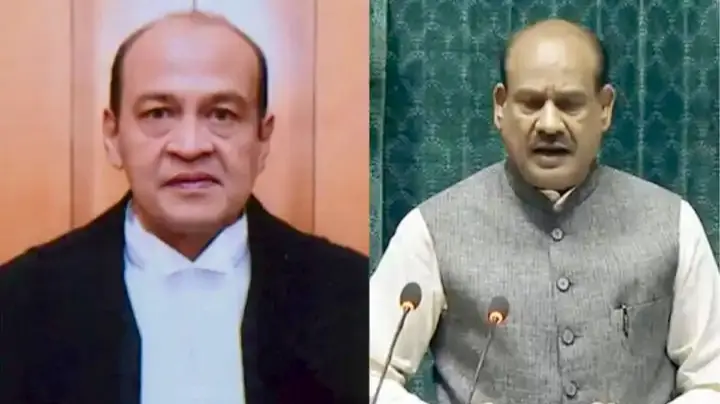
New Delhi: The Supreme Court, on Friday, dismissed a petition by Allahabad High Court judge Yashwant Varma, challenging Lok Sabha Speaker Om Birla’s decision to admit a motion seeking his removal and the legality of the parliamentary panel probing corruption charges against him.
A bench of Justices Dipankar Datta and SC Sharma, which had reserved its decision on January 8 on Varma’s plea, pronounced the verdict.
Justice Varma had claimed in his petition that the Lok Sabha Speaker had “unilaterally” constituted a committee under the Judges (Inquiry) Act to investigate him. The judge, represented by senior advocate Mukul Rohatgi, had said the constitution of the committee under Section 3(2) of the 1968 Act violated both his right to be treated and protected equally by the law. He argued that though notices of motion for removal were given in both Houses of Parliament on the same day, the Speaker constituted the committee unilaterally, as reported by NDTV.
The Supreme Court decided to examine his peti
tion – ‘XXX’ vs Union of India – on December 16, 2025.
At the root of all of this is a fire that broke out at Justice Varma’s official residence in New Delhi on March 15, 2025. He was then a judge of the Delhi High Court. Firefighters claimed that they found piles of money that had been burnt by a fire. This raised questions about corruption in the highest levels of the judicial system in the country.
While Justice Varma denied any link to the cash and called the allegations against him “preposterous”, the top court set up an in-house panel that recommended his impeachment. The panel’s report was forwarded to President Droupadi Murmu and Prime Minister Narendra Modi – by then Chief Justice of India Sanjiv Khanna – with with the same recommendation. Following this, Justice Varma wrote a petition challenging the top court panel’s recommendation to remove him.
He, however, kept his identity a secret in the petition – and was then referred to as ‘XXX’ in court documents.
In his writ petition, Justice Varma had offered the two-judge bench of Justice Dipankar Datta and AG Masih five reasons why he could not be sacked, including questions over the jurisdiction and authority of the in-house committee to investigate a sitting judge. The Supreme Court had, however, ruled that the Judge’s petition was “not worth entertaining” and reproached him for conduct that did not inspire confidence.