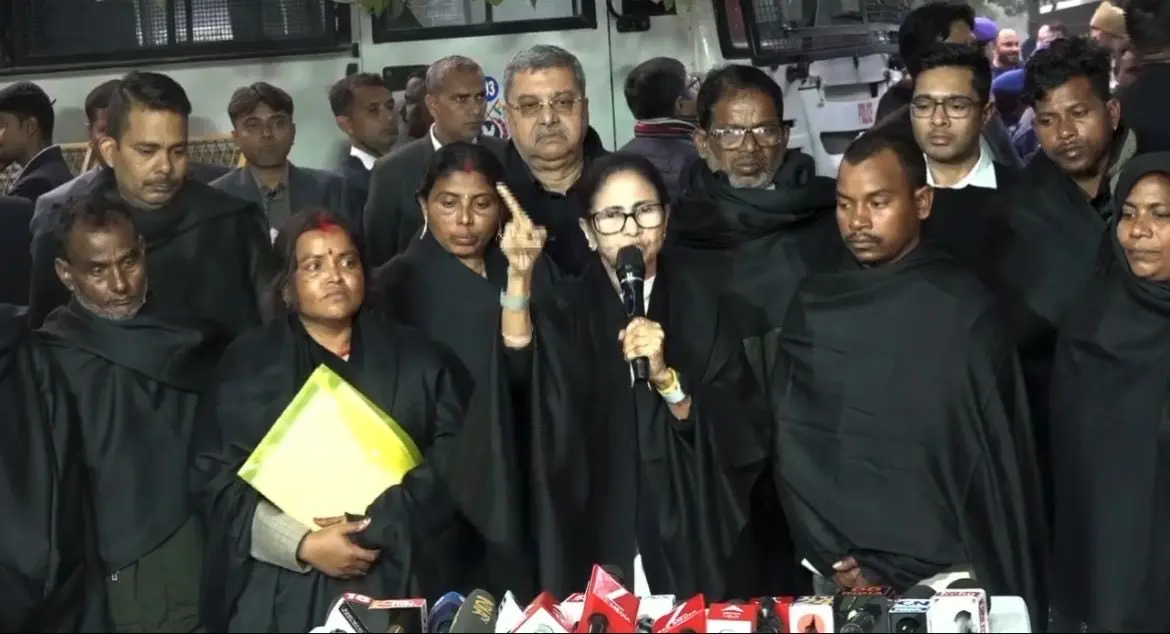
Kolkata: West Bengal Chief Minister Mamata Banerjee arrived at the Supreme Court of India on Wednesday as the apex court commenced hearing her plea challenging the Election Commission of India’s ongoing Special Intensive Revision (SIR) of electoral rolls in West Bengal. The high-profile legal battle marks a significant escalation in the ongoing confrontation between the West Bengal government and the Election Commission, with state elections looming.
She is likely to seek permission from the Chief Justice of India to argue the case in person. Through her legal team, she has filed an interim application requesting the court’s approval to make submissions directly, reported India Today.
Banerjee has filed a writ petition seeking to quash all SIR-related orders issued by the Election Commission — particularly notifications dated June 24, 2025 and October 27, 2025 — arguing that the entire exercise is unconstitutional, arbitrary, and likely to disenfranchise millions of voters in her state.
Her petition also names the Chief Election Commissioner (CEC) and the Chief Electoral Officer of West Bengal as respondents in the case. The West Bengal CM has demanded that the upcoming Assembly elections be held based on the 2025 voters list rather than a new list produced through the SIR process.
A bench led by Chief Justice Surya Kant, along with Justices Joymalya Bagchi and Vipul M. Pancholi, is hearing the batch of petitions filed by Banerjee and other petitioners, including TMC MPs and citizens alleging harm from the roll revision.
What’s in the peitition?
Her plea urges that the 2025 voter list be used without introducing fresh changes ahead of the Assembly elections in the state. It also asks the court to ensure that voters are not called for hearings over mino
r issues such as spelling errors.
The petition seeks directions from the Election Commission to make public the names of around 1.4 crore voters marked as “disputed,” and to accept Aadhaar as sufficient proof of identity in discrepancy cases.
It further calls for a halt to what it describes as mass deletions of voters through bulk Form-7 entries and for the withdrawal of 8,100 external micro-observers deployed in West Bengal’s electoral process, according to the India Today report.
The Election Commission launched the Special Intensive Revision of electoral rolls in West Bengal on November 4, 2025, with the draft roll published on December 16, 2025 and the last date for claims and objections set at January 19, 2026. The final electoral roll was scheduled for publication on February 14, 2026, though this timeline now faces uncertainty due to the legal hearings.
Banerjee and her party, the Trinamool Congress (TMC), have alleged that the SIR process in the state has resulted in mass voter deletions, procedural irregularities, and unfair notices, which they claim impact ordinary voters and disproportionately affect marginalised people.
In the lead-up to the Supreme Court appearance, Banerjee held a press briefing with individuals who say they were affected by the revision process, alleging that they were not given adequate opportunities to defend their inclusion in the electoral rolls. She has repeatedly sought suspension of the SIR exercise, describing the current process as overly harsh and poorly implemented.
The Supreme Court’s decision in this matter is expected to have far-reaching implications for the conduct of elections and the integrity of voter lists in West Bengal, especially with Assembly polls approaching.
Shiv Sena (UBT) MP Priyanka Chaturvedi backed Mamata Banerjee ahead of the Supreme Court. “I support what Mamata Banerjee is doing. She is fighting a legal fight from the front. If such arbitrariness of the BJP continues, we will fight the fight – whether it is through an Impeachment Motion or through any legal process…,” Chaturvedi told news agency ANI. She also said that the SIR exercise was conducted in a “one-sided manner” across states.