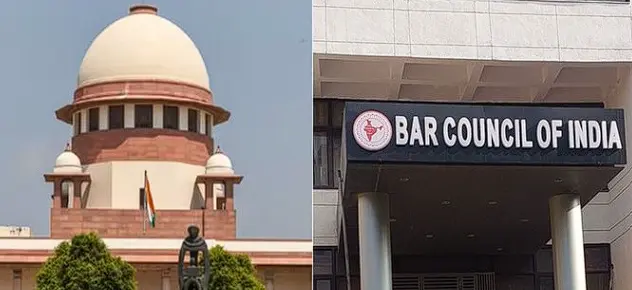
New Delhi: The Supreme Court on Wednesday raised doubts over the Bar Council of India’s authority to supervise and regulate universities and law colleges, saying it would first examine whether the BCI could be considered an expert body in legal education.
“The question is how the Bar Council of India is the expert body to regulate legal education. What do they know about legal education…there are law scholars, there is academia,” Chief Justice of India Surya Kant observed.
The bench, comprising the CJI and Justices Joymalya Bagchi and V Mohana, said the BCI could frame broad norms for legal education, including deciding whether a law course should be of four or five years. However, it questioned whether the council could exercise control over the functioning of law institutions.
The court was hearing petitions challenging the functioning of the BCI-PEARL FIRST Trust and its role in setting up law colleges, as reported by ETV Bharat.
Petitioners Question Trust’s Formation
Advocate Prashant Bhushan, appearing for the petitioners, submitted that the BCI had passed a resolution to dissolve an earlier trust and transfer its funds to a newly created one. He also referred to a pending Central Bureau of Investigation probe and questioned the circumstances surrounding the formation of the BCI-PEARL FIRST Trust.
Bhushan said the trust was involved in conducting the Bar examination and alleged that BCI chairman Manan Kumar Mishra had declared himself a lifetime trustee. He further claimed that the trust had set up one law college in Goa and another in Andhra Pradesh.
“How can BCI regulate law colleges?” the bench asked, describing this as the central issue. It added that the BCI’s statutory role came into play only after a person obtained a licence to practise law.
The judges said the matter would largely be resolved by determining whether law schools could be regulated by the BCI.
“First, we would like to examine whether the BCI has the power to regulate and control law universities,” the CJI said.
Court Distinguishes Guidelines From Control
During the hearing, a lawyer cited the Medical Council of India’s role in regulating medical education and allowing doctors to enrol.
The bench, however, said legal education should be overseen by people with expertise in the field. When another lawyer said the BCI included former judges and senior lawyers, the court said this only explained who was on the council, not whether it was qualified to regulate legal education.
“It has to be legal educationists…,” the bench said.
“It is only composition. The question is how the Bar Council of India is the expert body to regulate legal education. What do they know about legal education…there are law scholars, there is academia. They should be involved. They are at your mercy…,” the CJI observed.
The court said the BCI could issue broad rules, such as fixing the length of law courses, and take steps to promote legal education. But it said the council could not use these powers to control law colleges.
“But you cannot control it…,” the CJI said.
Senior advocate Shobha Gupta, appearing for the petitioners, said the BCI had declared its earlier trust defunct and described it as a burden. The council then dissolved the trust and shifted its assets to the new trust, she submitted.
Gupta also alleged that the trust collected crores of rupees in donations from colleges seeking approval.
The bench later issued notice on the applications and asked the BCI to respond.