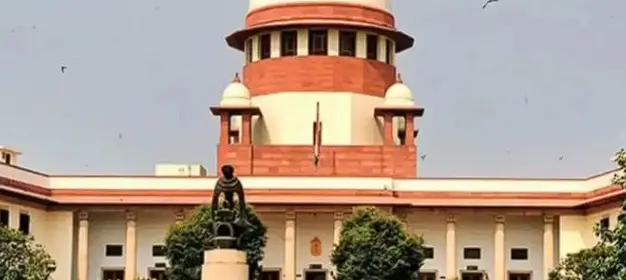
New Delhi: The Supreme Court on Wednesday referred petitions challenging the 2023 law governing the appointment of the Chief Election Commissioner and Election Commissioners to the Chief Justice of India for the constitution of a Bench of appropriate strength.
The order came from a bench of Justice Dipankar Datta and Justice Satish Chandra Sharma, who differed on whether the case should be referred to a larger Bench. However, they jointly decided that the matter should go before the CJI, instead of being first examined by a three-judge bench.
The court said such an exercise would only delay a ruling on the main constitutional questions.
“A decision by a three-judge bench on which of the two opinions is correct would be of little worth and only delay at the decision on the significant issues that are raised,” the bench said.
Challenge To 2023 Law
The petitions challenge the Chief Election Commissioner and Other Election Commissioners (Appointment, Conditions of Service and Term of Office) Act, 2023.
Under Section 7 of the Act, the committee that selects the CEC and Election Commissioners includes the Prime Minister, a Union Cabinet Minister nominated by the Prime Minister, and the Leader of the Opposition.
The petitioners have argued that the system gives the executive a two-to-one majority and affects the independence of the Election Commission.
They relied on the Supreme Court’s 2023 ruling in Anoop Baranwal v. Union of India, in which a Constitution Bench had prescribed an interim selection panel comprising the Prime Minister, the Leader of the Opposition and the Chief Justice of India. The arrangement was to operate until Parliament enacted a law.
The Centre has defended the legislation, saying Parliament has the power under Article 324 to decide the appointment procedure. It has also argued that the arrangement created in Anoop Baranwal was only temporary.
Differing Opinions
Justice Datta held that a reference to a larger Bench was not needed because the principle that the Election Commission must remain independent of executive influence had already been settled in Anoop Baranwal, s reported by LiveLaw.in.
Justice Sharma, however, said the case raises substantial constitutional questions, including the scope of Parliament’s power under Article 324. He said the issue should be considered by a Constitution Bench under Article 145(3).
Justice Datta also raised prima facie concerns over the selection process under the 2023 Act. He said a Cabinet Minister nominated by the Prime Minister cannot be expected to oppose the Prime Minister’s choice, leaving the Leader of the Opposition without an effective counterweight.
“Free and fair elections depend on a truly independent ECI. It is not enough for the ECI to be independent; it must appear to be independent. The member nominated by the Prime Minister cannot be expected to defy the Prime Minister,” Justice Datta observed.
Cricket Analogy
Justice Datta used a cricket analogy to underline the importance of public confidence in the appointment process. He said that even if an umpire selected by one team makes correct decisions, doubts may remain because the umpire was chosen by a party with an interest in the match’s outcome.
“The bottom line of the argument runs thus: it would not be a fallacious metaphor if it is said that since the umpire is picked by the captain of one side in a cricket match and his team wins, even if the decisions taken by such umpire are correct, it has the patina of suspicion, for at the end of the day the umpire has effectively been chosen by the winning captain. These are very emphatic and appealing submissions.”
The bench also expressed concern over the delay in hearing Constitution Bench cases and suggested the setting up of a permanent Constitution Bench for quicker consideration of major constitutional matters.