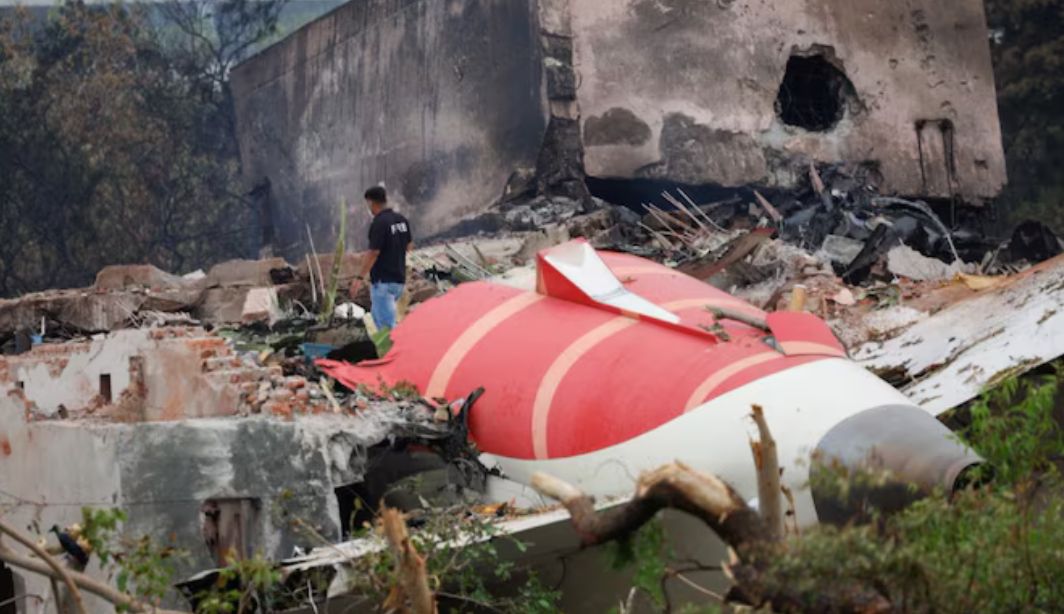
New Delhi: A key technical snag recorded just hours before the Air India Flight AI-171 crash is now under intense scrutiny as investigators probe whether a cockpit switch—central to the engine shutdown—could have been triggered without pilot input. The revelation, reported exclusively by The Indian Express, sheds new light on the June 12 tragedy that claimed 260 lives shortly after takeoff from Ahmedabad.
According to the report, the Boeing 787 Dreamliner had reported a defect in the Stabilizer Position Transducer during its previous leg from Delhi to Ahmedabad. This malfunction is being examined for its potential to have caused cascading errors in flight control systems, possibly interfering with the aircraft’s Full Authority Digital Engine Control (FADEC) and triggering the engine fuel control switches.
Crucially, the cockpit voice recorder captured a chilling exchange between the two pilots: one asked, “Why did you cut off?” to which the other responded, “I didn’t.” The Aircraft Accident Investigation Bureau (AAIB) has confirmed that both engine fuel control switches were found in the “CUTOFF” position within seconds of takeoff—effectively shutting down fuel supply and dooming the flight.
What makes the incident particularly alarming is the highly secure design of these fuel switches. Industry sources told the Indian Express that they are mechanically locked in place and require deliberate manual action to move—making accidental engagement extremely unlikely. This has raised serious concerns over whether the switches could have shifted to CUTOFF due to an electronic or software failure linked to the earlier transducer defect.
The report further cited senior investigators who noted that any scenario involving “un-commanded” movement of the switches would indicate a deeper systemic issue—one that could involve interactions between multiple aircraft systems, such as electrical power supply, FADEC logic, or faulty sensors.
This new angle significantly complicates the preliminary narrative that focused on possible human error. Boeing and the Directorate General of Civil Aviation (DGCA) are both closely monitoring the findings, while the AAIB is now examining whether a chain of automated commands or a software glitch—rather than a deliberate pilot action—led to the engines being cut off mid-air.
The aircraft had earlier flagged fuel imbalance warnings during the Delhi–Ahmedabad flight, and while these were reportedly cleared after ground checks, the Express reports that technicians had logged the stabilizer transducer issue prior to the London-bound flight.
While the final AAIB report is expected later this year, the technical malfunction documented hours before the crash has emerged as a critical lead. Aviation experts, as cited by The Indian Express, warn that if proven, it could have wide-ranging implications for aircraft design safeguards and automated system protocols.