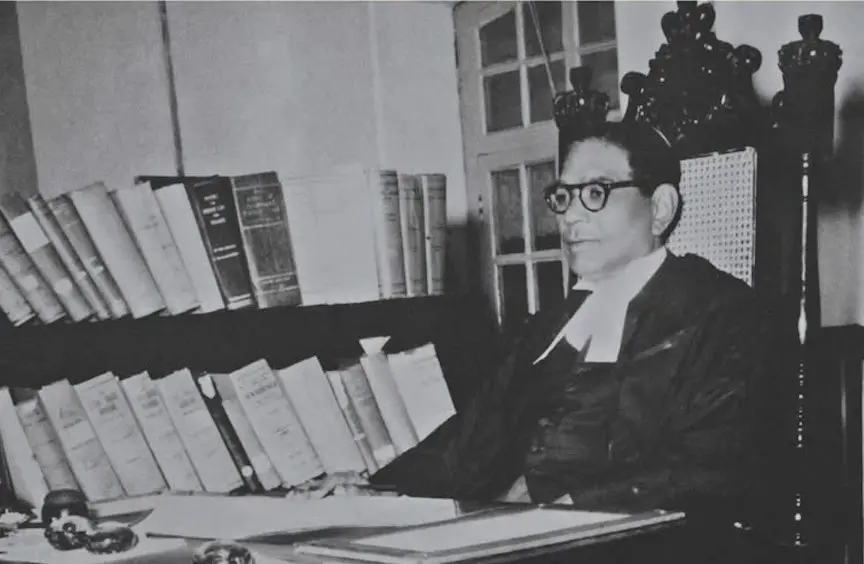
Kataka: The establishment of the Orissa High Court stands as a defining chapter in the state’s constitutional and judicial history, a monumental shift driven by a quest for administrative efficiency, political statehood, and local legal autonomy. At the centre of this transition was Justice Bira Kishore Ray, a visionary jurist who laid the foundation for an independent High Court and shaped its early ethos of impartial justice.
Born into a royal lineage of Nayagarh on October 21, 1891, before his family settled in Baghalgarh, Ray demonstrated early intellectual brilliance. A graduate of the erstwhile Ravenshaw College, he earned his law degree from Calcutta University, where his formidable legal acumen caught the attention of the renowned educator and jurist Sir Ashutosh Mukherjee. After observing Ray’s performance in a moot court, Sir Ashutosh famously predicted that the young lawyer was destined to reach the apex of the legal profession. He practised law for 15 years before taking on high offices. He chaired the Orissa Court Committee in 1943 and became the first Odia judge on the Patna High Court at age 54.
The Visionary behind the Court
Following the creation of Orissa as a separate province in 1936, the region remained dependent on the Patna High Court, relying on a circuit court system in Cuttack. This setup proved inadequate to address the mounting backlog of cases, creating severe administrative delays.
In response, the Government in Orissa constituted a committee in 1943, chaired by Justice Ray, to examine the feasibility of a dedicated High Court. The committee’s report, submitted on December 27, 1943, made a compelling case. It argued that a self-governing province required its own apex court to achieve constitutional completeness. The panel highlighted severe delays caused by the circuit system, prolonged detentions of under-trial prisoners, and demonstrated that a three-judge High Court could be sustained financially through existing court fee revenues at an estimated annual cost of around Rs. 2,01,960.
Justice Ray’s leadership in this effort proved decisive. Elevated to the Bench of the Patna High Court in 1945, he was ideally positioned when the Orissa High Court Order, 1948, was issued. On July 26, 1948, the High Court of Orissa was formally inaugurated in Cuttack in a ceremony attended by the nation’s top legal luminaries. Justice Hiralal J Kania, the first Chief Justice of India, inaugurated the court, while Governor Asaf Ali presided. Among those present were Premier of the province Dr Harekrushna Mahtab and Former Governor of Orissa and Governor of West Bengal Dr K N Katju.
That historic day, Justice Ray was sworn in as the first Chief Justice of the Orissa High Court, serving alongside Justices Bachu Jagannadh Das, Lingaraj Panigrahi, and R L Narasimham.
During his inaugural address, Chief Justice Ray articulated an unwavering ethos of ideal justice: “Their Lordships fully realise that it is up to this High Court to uphold the rights, privileges and liberties of the people, who are entitled to possess them unaffected and unmolested by any power on earth except through due process of law… to stand firm on the solid rock of ideal justice tempered with mercy, which knows no distinction between the rich and the poor, the subject and the State, and the mass and the class.”
Under his stewardship, the court set early precedents in statutory interpretation, notably in landmark cases such as Siba Prasad Mishra v. Mst. Nurabati (1948).
He retired as Chief Justice on October 30, 1951, and subsequently entered electoral politics, winning the Cuttack Lok Sabha seat uncontested. Justice Ray passed away on July 26, 1958, exactly ten years to the day after the inauguration of the High Court he had helped establish and led as its founding Chief Justice. He was 67.
Decades later, his pioneering contributions as an advocate, legislator, and judge remain the enduring cornerstone of Odisha’s legal framework.