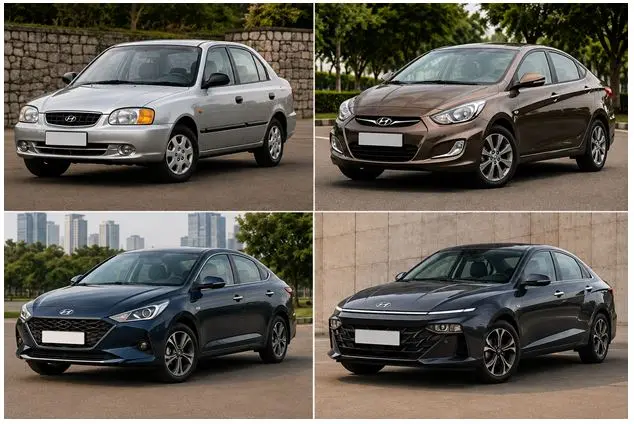
The Hyundai Verna has occupied India’s C-segment sedan market for long enough to have built up a multi-generational used car presence. Depending on your budget and your expectations, you could be looking at a Verna from 2017, from 2020, or from 2023, and these are meaningfully different cars. Understanding what each generation actually offers, and what each one’s specific pre-owned risks are, is how you match the right Verna to your budget and use case. Browsing used Verna listings without knowing which generation you are looking at is how buyers end up with the wrong car for their budget. The Verna also sits as one of the more interesting options in the second-hand Hyundai cars segment for buyers who prefer a proper sedan over an SUV.
The 2017 Verna (Fourth Generation)
This was the generation that felt like a genuine reinvention. Hyundai replaced the previous rounded design with a sharper, sportier exterior, the car that launched the trend of aggressive front-end grilles in Indian mid-sedans. Engine options were wide: a 1.4-litre petrol (100ps), a 1.6-litre petrol (123ps), a 1.4-litre diesel (90ps), and a 1.6-litre diesel (128ps). The 1.6-litre diesel with a 6-speed torque converter automatic was the flagship combination and remains a strong mid-range used buy today, especially when it comes to Second-Hand Hyundai Cars in India.
In the pre-owned market, the 2017-2020 Verna sits in the ₹6-10 lakh range, and it’s an excellent value if you can verify the maintenance history. The diesel variants need the timing belt checked, this is a scheduled replacement item, typically around 60,000-80,000 km, depending on the service protocol, and the automatic transmission fluid should have been changed at proper intervals. Well-maintained examples of the 1.6 diesel AT are among the better-value sedans in the used market for buyers who want a proper rear-seat-focused family car.
The 2020 Facelift
The 2020 facelift of the fourth-gen Verna updated the exterior and interior but didn’t change the fundamental engineering significantly. It did add some variant-specific features, a 10.67-inch touchscreen in top trims, wireless charging, and a revised instrument cluster. These cars sit a price band higher than the 2017-era cars in the used market, but the mechanical underpinnings are the same.
The 2023 Verna (Fifth Generation)
This is a comprehensively new car. Hyundai moved to a new platform, new engines, a 1.5-litre naturally aspirated petrol at 115ps, a 1.5-litre turbo-petrol at 160ps, and a 1.5-litre diesel at 115ps, and a new interior design with a panoramic curved screen that integrates the instrument cluster and infotainment into a single widescreen unit. The turbo petrol with 7-speed DCT is the enthusiast choice; the NA petrol with IVT (Intelligent Variable Transmission, essentially a CVT) is the smooth commuter choice.
The 2023 Verna is just entering the pre-owned market in small numbers, typically cars that were purchased by early adopters and are now being upgraded. These will be priced relatively close to new car levels in the near term.
For most buyers looking at a Used Verna who want the right balance of price and features, the 2017-2020 Verna in petrol or diesel (depending on annual mileage, diesel makes more sense above 15,000-18,000 km/year) is the sweet spot. The car is spacious, has proven reliability, and is well-supported by Hyundai’s service network.
Checking the broader range of second hand Hyundai cars alongside the Verna is worthwhile, the Grand i10 Nios for budget buyers, the Creta if you want SUV proportions, and the Elantra if you want an older premium sedan experience. But for the classic family sedan in the mid-budget used segment, the Verna’s generation story gives you a clear framework for choosing the right car at the right price.
The post-purchase service cost comparison between generations is worth understanding in practical terms. The first-generation Verna diesel’s timing belt replacement, typically recommended around 60,000-80,000 km, is a scheduled cost that runs ₹12,000-₹18,000 at an authorised centre. On a fourth-generation diesel with a timing chain, this particular cost doesn’t exist, which changes the 100,000 km total cost of ownership meaningfully.
The resale value trajectory also differs by generation. First-gen cars have already depreciated substantially and offer the lowest absolute purchase price with the most remaining depreciation risk. Fourth-gen cars depreciate from their new-car peaks but still retain more residual value. The third-generation sitting between, 2018-2020, is often the value-maximising generation for buyers who plan to hold the car for three to five years and then sell, because it balances current price with a reasonable resale expectation at exit.
One final note specific to the 2023 fifth-gen Verna: the turbo petrol in this generation is significantly more powerful (160ps) than any previous Verna engine, and the 7-speed DCT shifts sharply enough to make it genuinely engaging to drive quickly. For buyers who appreciate a more dynamic sedan experience, this generation in the used market offers something no previous Verna did, an enthusiast-oriented powertrain in a practical body.