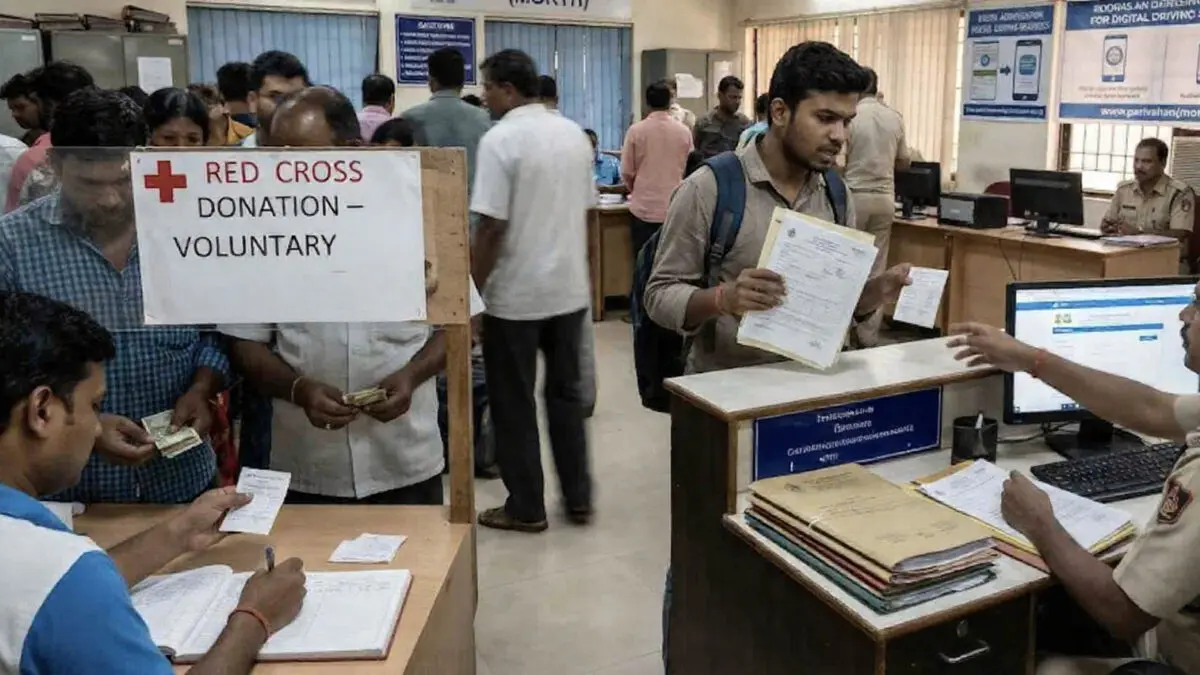
Bhubaneswar: Imagine in a digitised age, especially when the state and central governments are advocating and spending crores of public money to digitise public utility services, a simple application for a driving licence, change or ownership of a vehicle or even as minor as deleting the hypothecation attached to a car or bike is stopped at the final counter at a Regional Transport Office by an official clerk with an unexpected instruction: “Go to the next counter and get the Red Cross done, and bring back the receipt”.
At the Regional Transport Office (RTO) II in Bhubaneswar, this sequence is a daily administrative reality. What is framed officially as a benign, voluntary contribution to the Indian Red Cross Society functions on the ground as a strict, mandatory bottleneck. For citizens, this practice exposes deep systemic friction, raising critical ethical, legal, and technological questions about how public offices operate.
The Statutory and Legal Distortion
The mechanics behind these collections rely on a convenient administrative overlap. Under the Indian Red Cross Society Act, 1920, the Khordha Collector serves as the ex-officio Chairman of the local Red Cross branch. Because the Collector also wields administrative authority over the district’s public offices, non-statutory donation desks are permitted directly inside government premises. Legally, however, an RTO operates strictly under the Central Motor Vehicles Rules and the statutory frameworks of the Odisha Motor Vehicle Department. These statutes outline the precise, exhaustive schedule of fees required to process citizen services. Nowhere does the law authorise an RTO clerk to pause, delay, or hold a citizen’s application file hostage over a third-party charitable donation.
Utilising tax-funded government infrastructure, desks, and salaried personnel to enforce a non-transport fundraising drive distorts the operational purpose of a public office. When a public servant conditions a statutory service on an unrelated cash payment, citizen choice is erased, and “voluntary” becomes functionally coercive.
The Digital Disconnect
This practice stands in sharp contrast to India’s massive push toward “faceless” digital governance. Portals like Parivahan were built to eliminate human intervention, reduce corruption, and streamline citizen services through online tracking. Because Red Cross donations are not legal transport fees, they cannot be integrated into central digital payment systems. This structural limitation actively forces citizens back into manual, offline processing counters. Requiring an applicant to step out of a digital workflow to make a physical cash payment directly undermines the Union and State governments’ paperless mandates. It forces a regressive, manual step onto an otherwise modernised, automated platform.
The Transparency Black Hole
The issues deepen when looking at the financial execution of these donations. Even for small contributions, like ₹10 or ₹20, basic financial and taxpayer rights are routinely ignored. Under India’s Income Tax Act, charitable donations qualify for tax deductions under Sections 80G and 12A. Yet, the manual paper slips handed out at these RTO counters lack the mandated digital validation, unique transaction IDs, or 80G integration needed for a donor to claim tax benefits.
Furthermore, there is a total absence of post-payment feedback loops.
In a functioning digital economy, even a micro transaction triggers an automated SMS or email receipt containing links to programme data. Here, the money disappears into a financial black hole. Donors receive no annual reports, no digital statements, and no programmatic breakdowns showing how their money is utilised by the Khordha Red Cross fund.
Conclusion
While supporting humanitarian causes is inherently noble, tying charitable funding models to essential public service delivery sets a dangerous administrative precedent. It breeds high-handedness and leaves room for systemic leakage. If the state wishes to support the Red Cross, the process must be updated. It should be fully digitised, integrated as a transparent, clearly labeled, and genuinely toggleable checkbox on the online portal, and backed by automated digital reporting.
Until then, the current counter system remains an unethical exercise of official patronage that compromises the integrity of public administration.
(Views expressed by the columnist are personal and do not necessarily reflect the opinion or policy of the news portal)