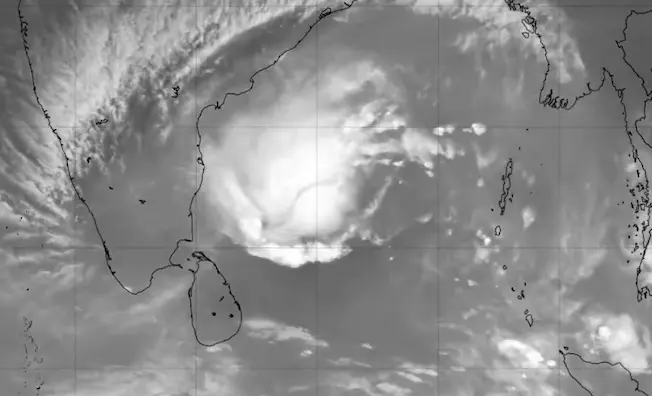
Bhubaneswar: The Bay of Bengal is brewing its third cyclone in as many weeks. The system is expected to intensify into a storm by the evening of November 16 and head towards Andhra Pradesh coast as a very severe cyclonic storm by November 19. Once it reaches storm strength, it will be named ‘Akvan’ (meaning ‘an evil mind’), a name proposed by Iran.
Whether they leave a trail of devastation or pass quietly out at sea, tropical storms frequently make headlines under memorable, sometimes quirky monikers like ‘Gati’, ‘Nisarga’, and ‘Nivar’. While these names often spark curiosity, they are the result of a coordinated international system designed to streamline communication and save lives.
From Saints to Global Lists
Technically, cyclones, hurricanes, and typhoons are the exact same meteorological phenomenon—intense tropical storms with sustained wind speeds reaching or exceeding 74 miles per hour—with their titles varying strictly by geography. Storms are called hurricanes in the Atlantic, typhoons in the Pacific, and cyclones in the Indian Ocean.
The practice of naming storms began centuries ago in the Atlantic Ocean when a hurricane was named ‘Antje’ after it ripped the mast off a boat bearing the same name. Initially, any tropical storm with sustained winds of 39 miles per hour was given a name. For hundreds of years, residents in the Caribbean named storms after the Roman Catholic saint of the day on which the storm occurred.
This tradition persisted until World War II, when meteorologists began using exclusively female names. By 1953, the US Weather Service formalised this into an international phonetic alphabet of women’s names from A to W (excluding Q, U, X, Y, and Z). However, during the women’s liberation movements of the late 1960s and 1970s, activists criticised the practice of associating only women with destructive weather. Consequently, male names were introduced in 1978, establishing the modern practice of alternating male and female names across six rotating lists.
Naming Storms in the North Indian Ocean
Today, the World Meteorological Organization (WMO) oversees storm naming across nine global regions, ensuring meteorologists never run out of monikers. In the North Indian Ocean—covering the Bay of Bengal and the Arabian Sea—naming protocols began in 2000, though an official formula was only finalised in 2004, which is why Odisha’s catastrophic 1999 Super Cyclone went unnamed.
Under the 2004 framework, eight countries—Bangladesh, India, Maldives, Myanmar, Oman, Pakistan, Sri Lanka, and Thailand—contributed eight names each, creating a pool of 64 names assigned sequentially by the Regional Specialised Meteorological Centre (RSMC) in New Delhi. The very first storm named under this system was Onil (suggested by Bangladesh) in 2004, while later infamous storms included Phailin (contributed by Thailand) and Titli (contributed by Pakistan).
By 2020, 63 of those original 64 names had been exhausted, leaving only Amphan (suggested by Thailand). To prepare for future seasons, the India Meteorological Department (IMD) released a fresh roster of 169 cyclone names adopted by the WMO/ESCAP Panel in April 2020. Five new member nations—Iran, Qatar, Saudi Arabia, the United Arab Emirates, and Yemen—joined the original eight countries, with each of the 13 nations contributing 13 names.
India’s 13 contributions to the 2020 list include Gati, Tej, Aag, Neer, Vyom, Jhar, Jaladhi, Murasu, Probaho, Prabhanjan, Ghumi, Ambud, and Vega—with Neer and Murasu specifically drawn from Tamil. Following Amphan, the new list kicks off with names such as Nisarga (Bangladesh), Gati (India), Nivar (Iran), Burevi (Maldives), Tauktae (Myanmar), and Yaas (Oman).
Severe Cyclonic Storm ‘Murasu’ made landfall along the Andhra Pradesh coast between Bapatla and Prakasam districts on November 2. While the storm caused widespread destruction in coastal Andhra Pradesh, neighbouring Odisha largely escaped severe direct damage and primarily experienced rainfall, though it had already been battered by Cyclone Arnab days earlier (October 28), which severely affected Odisha’s southern districts, particularly Ganjam, Gajapati and Kandhamal. Ganjam witnessed devastating floods after unprecedented rainfall during the cyclone’s landfall and subsequent movement over land. At least 11 people were killed, and six others remained missing in incidents linked to the cyclone.
Why Names Matter And When They Are Retired
The reasoning behind naming cyclones is entirely practical: short, distinctive names are far easier for the public, the media, coastal bases, ships at sea, and weather stations to remember and track than technical longitude and latitude coordinates. Calling a storm “Cyclone Fani” or “Cyclone Phailin” eliminates confusion, especially when multiple weather systems are active simultaneously.
However, when a storm causes massive loss of life and widespread destruction, its name is permanently retired out of respect for the victims and to avoid confusion in historical and legal records. An annual meeting of the WMO Tropical Cyclone Committees strikes these names from the roster for at least a decade, replacing them with a new name of the same gender and starting letter. Since 1972, roughly 50 devastating storm names have been retired globally, including Mitch (1998), Katrina (2005), Sandy (2012), and Haiyan (2013).