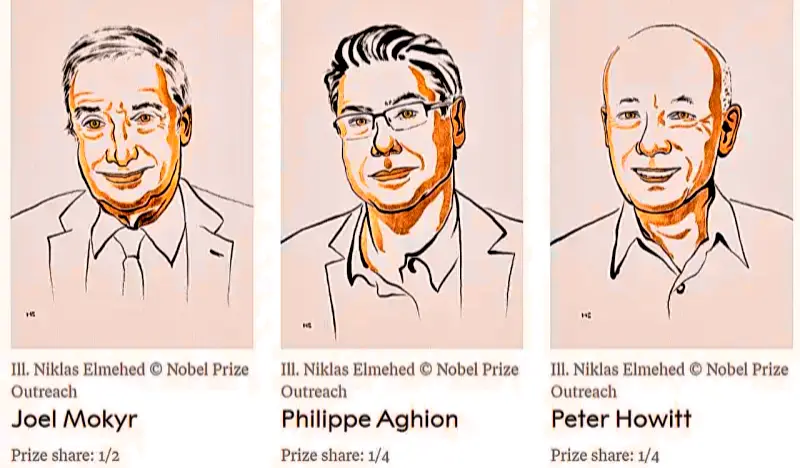
Oslo: The Royal Swedish Academy of Sciences has awarded the 2025 Sveriges Riksbank Prize in Economic Sciences in Memory of Alfred Nobel to Joel Mokyr, Philippe Aghion and Peter Howitt “for having explained innovation-driven economic growth”.
While half will go to Mokyr “for having identified the prerequisites for sustained growth through technological progress” the other half will jointly go to Aghion and Howitt “for the theory of sustained growth through creative destruction.”
This is the final prize of the Nobel season. The awards will be given away in Stockholm in December.
Mokyr used historical sources as one means to uncover the causes of sustained growth becoming the new normal. He demonstrated that if innovations are to succeed one another in a self-generating process, we not only need to know that something works, but we also need to have scientific explanations for why. The latter was often lacking prior to the industrial revolution, which made it difficult to build upon new discoveries and inventions. He also emphasised the importance of society being open to new ideas and allowing change.
Philippe Aghion and Peter Howitt studied the mechanisms behind sustained growth. In an article from 1992, they constructed a mathematical model for what is called creative destruction: when a new and better product enters the market, the companies selling the older products lose out. The innovation represents something new and is thus creative. However, it is also destructive, as the company whose technology becomes passé is outcompeted.
Nobel purists insist that the economics prize is technically not a Nobel Prize. However, it is presented together with the other awards on December 10, the anniversary of Nobel’s death.
Nobel prizes in medicine, physics, chemistry, literature and peace were awarded last week.
The 2024 award went to three economists — Daron Acemoglu, Simon Johnson and James A Robinson — who looked into why some countries are rich and others poor. Their research also found that freer, open societies were more likely to do better.
Since 1968, the prize been given out 56 times to 96 people, including two Indians.