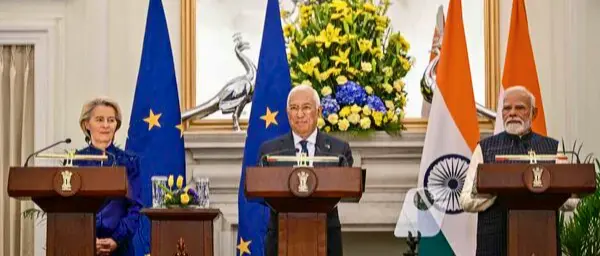
New Delhi: India and the European Union (EU) signed the much-awaited Free Trade Agreement (FTA) on Tuesday, with leaders outlining the scope and intent of the trade deal, alongside a wider push to deepen strategic ties.
Among the major decisions taken, automobile tariffs will fall sharply, with duties on cars set to reduce gradually from 110% to as low as 10%. Tariffs on car parts will be fully eliminated within five to ten years, as reported by NDTV Profit.
Agri-food tariffs will also drop across several categories. Wine duties will be cut from 150% to 75% initially and reduced further to as low as 20% over time. Olive oil tariffs will fall from 45% to zero over five years, it has been announced.
While sensitive European agricultural sectors will remain protected, beef, chicken, rice and sugar have been excluded from tariff liberalisation.
As per the agreement, EU companies will gain privileged access to India’s services market, including financial services and maritime transport. India has made its deepest commitments so far in services trade under this arrangement.
The FTA also includes sustainability and climate commitments, with plans for an EU–India climate cooperation platform and up to 500 million euros in EU support for India’s green transition, subject to procedures.
Prime Minister Narendra Modi held a joint briefing with Euro
pean Commission president Ursula von der Leyen and European Council president António Luís Santos da Costa, describing India–EU ties as a partnership aimed at global good.
The engagement between the world’s two largest democratic powers marked a new chapter in relations and could provide stability at a time of global uncertainty, Modi said. He said the announced deal would support investment, innovation and stronger supply chains, calling it India’s largest trade arrangement to date and a blueprint for shared prosperity. He added that cooperation would extend beyond trade, from the Indo-Pacific to the Caribbean.
The partnership carried personal meaning for him due to his family roots in Goa, Costa said and reflected deep historical and people-to-people ties. He said India and the EU share responsibility as major democracies to uphold the principles of the UN Charter and a rules-based international order. Trade acts as a geopolitical stabiliser and the announced deal ranks among the most ambitious outlined, with the potential to link a market of about two billion people, he added.
According to Von der Leyen, the announcement delivered what she described as the “mother of all deals” and marked a defining moment in India–EU relations. She said the partnership represents a win-win outcome and the beginning of deeper political, economic and strategic engagement. Drawing a parallel with Makar Sankranti, she said the time was right to open a new chapter in EU–India friendship.
India and the EU also announced a new Security and Defence Partnership to deepen cooperation in the defence industry and maritime security. Von der Leyen said the move reflected trust between the two sides and the nature of reliable partners working together.