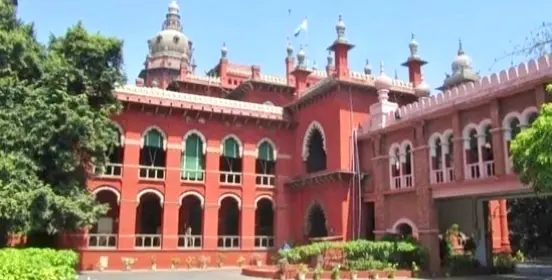
Chennai: The Madras High Court has held that Tamil Nadu deputy chief minister Udhaynidhi Stalin’s remarks against Sanatan Dharma come under the ambit of “hate speech” while quashing an FIR registered against BJP’s Amit Malviya for his tweets criticising the same.
Malviya had only reacted to the speech made by the minister and continuing any proceedings against him for such reaction would be an abuse of the process of law and would cause him irreparable harm and injury, Justice S Srimathy observed. While no case had been registered against the minister for his hate speech in the case, it was painful that a hate speech case was registered against the person reacting to it, the court noted.
“This Court with pain records the prevailing situation that the person who initiates the hate speech is let scot-free, but the persons who reacted for the hate speech are facing the wrath of the law. The Courts are also questioning the persons who reacted but are not putting the law on motion against the person who initiated the hate speech,” the court observed, as reported by Live Law.in.
Udhaynidhi had made the speech in 2023 while attending an event titled ‘Sanathan Abolition Conference,’ organized by the Tamil Nadu Progressive Writers Artists Association. In his address, the minister had compared Sanatan Dharma to dengue and malaria and called for its eradication. Cases were filed in the Madras High Court and the Supreme Court against the minister.
Malviya was accused of posting the video of the speech on his social media, and commenting that Udhaynidhi had called for genocide of 80% people in Bharat who were practicing Sanatan Dharma. The complaint was lodged by KAV Thinakaran, district organiser of DMK’s advocate wing, Trichy South, following which a case was registered against Malviya for offences punishable under sections 153, 153A and 505(1)(b) IPC, 1860. The BJP IT chief had approached the court seeking to quash this FIR.
It was argued by Malviya that he had merely extracted the Minister’s speech, which was already in the media, and had expressed his understanding of it, questioning its object and purpose. The minister’s speech was of a grave nature and had the potential to inflame hatred and encourage violence against a majority of citizens of Bharat who follow Sanatan Dharma, he argued, claiming that the allegations against him are false, absurd, and politically motivated.
It was claimed by the prosecution that Malaviya had distorted Udhaynidhi’s speech and spread fake news as if the minister had called for the genocide of 80% majority population. It was argued that Malviya had shared posts in the Hindi language, also, to create enmity between different groups of people, demolish the social fabric, and to cause unrest i
n the country.
It was also pointed out by the prosecution that after Malaviya’s posts, a seer, Paramhans Acharya of Ayodhya, had announced a reward of Rs 10 crore for beheading the minister.
After examining the matter, the Court held that Malaviya had not asked any people to start any agitation either against Udhaynidhi or his party, but only put forward facts and questions. Malviya had only sought replies from the deputy chief minister, and the same would not attract any of the ingredients of the sections charged, the Court noted.
After submissions that Malviya had interpreted a hidden meaning of Udhaynidhi’s speech, the Court noted that the party to which the minister belonged had repeatedly stated several things about Sanatan Dharma, and the overall circumstances leading to the present case would have to be considered.
That there were records of specific incidents where Hinduism had been attacked by the party by garlanding Lord Ram’s idol with slippers or breaking Ganesha idols, the Court noted, while observing that complaints were preferred but not acted upon except in a few cases.
“Therefore, it is evident that there is a clear attack on Hinduism by the Dravida Kazhagam and subsequently along with by Dravida Munnetra Kazhagam, for the past 100 years, to which the minister belongs. While considering the overall circumstances, it is seen the petitioner had questioned the hidden meaning of the minister’s speech,” the court observed.
The minister’s speech was against 80% Hindus and was within the mischief of hate speech, the Court observed, adding that Malviya, who was a Sanatani and victim of such hate speech, had only defended the Sanatan Dharma and the same would not attract any of the provisions of IPC.
“Hence by overall consideration the speech of the minister would clearly indicate it is totally against 80% Hindus, which come within the mischief of hate speech. The minister hails from the above legacy. Therefore, based on the above background the speech of the minister is hate speech only. The petitioner who is a sanathani is a victim of such hate speech and has only defended the Sanatan Dharma from the hate speech,” it was held by the Court.
The HC also held that Udhayanidhi’s speech could imply genocide.
“The word “abolish” would indicate “that some existing thing should not be there. If it is applied to the present case, if Sanatan Dharma should not be there, then the people following Sanatan Dharma should not be there. It means suppression of activities that do not conform to the destroyer’s notion. Then the above synonym words stated supra are applicable. If a group of people following Sanatan Dharma should not be there, then the appropriate word is “genocide”. If Sanatan Dharma is a religion, then it is “Religicide”. It also means to eradicate the people by following any methods or various methods with diverse attacks on ecocide, factocide, culturicide. Therefore, the Tamil phrase “Sanathana Ozhippu” would clearly mean genocide or culturicide. In such circumstances, the post of the petitioner questioning the minister’s speech would not amount to hate speech,” the Court held.