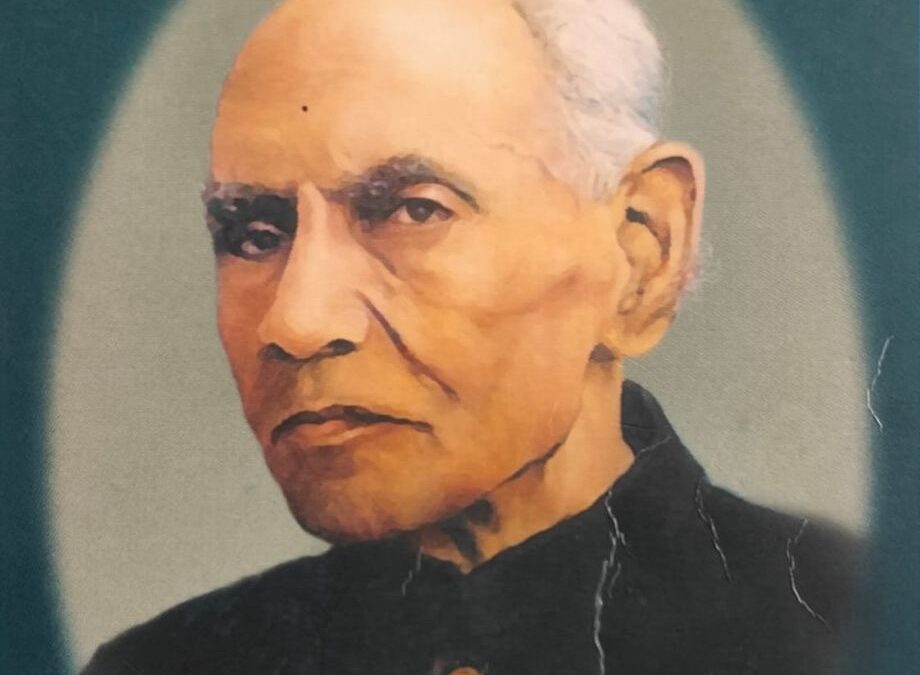
It’s the 132nd birth anniversary of Paramananda Acharya, one of the great personalities of Odisha.
Born on August 29, 1893 in Baidipur village, close to Baripada, he is the first person to receive Padma Shri from India’s first Prime Minister Jawharlal Nehru in 1964, for his contributions to the field of Archaeology.
Baripada Municipality chairman Badal Kumar Mohanty and other dignitaries garlanded the statue of Paramananda in front of his residence in Baripada on Padmashri Paramananda Acharya Marg and held puja. The road from K C Circle to Jagannath temple, Baripada was named after Parmananda many years ago.
He is renowned for establishing museums in Odisha, including the state museum in Bhubaneswar.
The Odisha State Museum, where he had been the Superintendent, will be organising a memorial lecture on August 31.
Paramananda is also credited to have reconstructed the destroyed Khiching temple, made of green stone (chlorite slabs), in Mayurbhanj.
He gave a new history of Odisha based on the scientific study of archaeological evidences found from excavations in the valleys of Baitarani, Brahmani and Mahanadi rivers.
His explorations in Talcher led to the discovery of large images of Anantaseyi Vishnu at Sarang and Bhimakand. He also discovered the temples at Vajrakot.
He played a pivotal role in placing Odisha on the world’s prehistoric archaeological map.
By finding pieces of Paleolithic and Neolithic implements near Harichandpur, he showed the evidence of early stages of human civilisation in Odisha.
Paramananda studied different stones used in Odishan temples and identified the quarries from which these were procured.
He made invaluable contributions to the art, architecture and archaeology of Odisha, and wrote innumerable articles in scholarly journals.
He is known for his studies on the stylistic evolution of temple architecture in Odisha including the Puri Jagannath temple.
It was he who made Raja Rama Chandra Dev of Puri remove the plaster of Jagannath temple, bringing to light the decorations and architectural wonders buried at a depth of one foot of plaster including the statue of Vayu.
Through his studies, Paramananda made an important historical correction. He pointed out that the Ananta Vasudev temple in Bhubaneswar, built in 1728, was actually built by Chandrika Devi, daughter of renowned Ganga king of Odisha Anangabhima Dev, and not by Bhattta Bhavdev, the minister of Harivarma Dev of Bengal, as it was believed till then.
Extremely keen to spread education, Paramananda helped and inspired a large number of students to follow their ambition.
Deeply interested in culture and literature, he translated Matthew Arnold’s poem ‘Sohrab and Rustum’ into Odia.
His 96-year-old daughter Niroo Mohapatra, who is herself an artist from J J School of Art, Bombay and Shantiniketan, recalls: “My father had been sent to London in that age to study Archaeology by the Maharaja of Mayurbhanja Purna Chandra Bhanja. My father used to cycle through jungle for days to reach Khiching to rebuild the mandir from rubble. During his school days he did not mind swimming across the Budhabalanga river daily to reach the school.”
Paramananda has truly been an inspiration for a lot of people, both in the family and outside. His influence seems to have played a part in making one of his granddaughters become an anthropologist, a grandson becoming a professor of Ancient India History, Culture and Archaeology and myself (a grandson) becoming a journalist and author of a book titled ‘Delhi: A City of Museums’!