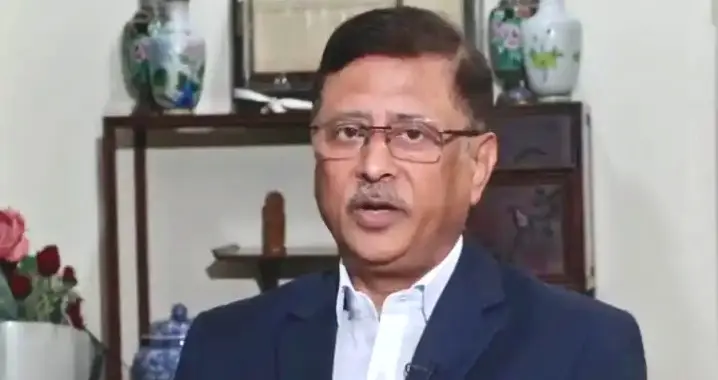
New Delhi: Former former Canadian Prime Minister Justin Trudeau was “ill-advised” to publicly accuse India of being involved in the killing of Khalistani separatist Hardeep Singh Nijjar, Sanjay Kumar Verma, who has been the Indian high commissioner to that country, said.
This move by the former Canadian leader placed a robust bilateral partnership under significant strain, Verma noted in an interview with ANI.
His comments followed recent clarifications from Canada’s national police chief, Mike Duheme, confirming that there is currently no evidence connecting the Indian state to the Nijjar case.
This was an issue that had previously sparked a major diplomatic fallout between the two nations.
The former envoy reflected on Trudeau’s past claims of “credible allegation,” describing the decision to go public as misguided.
“He was ill-advised. The timing was of his choosing, but he was ill-advised to put a very strong bilateral relationship on hold and move ahead with his political, I would say, motives,” the diplomat said.
He went on to deconstruct the narrative surrounding the accusations, questioning the persistent lack of tangible proof or legal proceedings.
“So let’s try to sort of dissect that. And if we say credible allegations, it was still not evidence. But due to some reason, the then Prime Minister thought it appropriate to state that in their own Parliament. I did not consider it well thought of on his part,” Verma remarked.
He pointed out the inconsistencies in the Canadian narrative over the past year.
“But t
hen moving ahead, even RCMP [Royal Canadian Mounted Police] in October 2024 said that they have credible evidence linking transnational repression and crime with Indian agents and proxies. Now even that has failed. Now my only question to those who had levelled these charges is if there was such clinching evidence, why the charges have not been filed so far? So I look at it both from the logical point of view as well as from the international law point of view,” he said.
India has firmly maintained that the claims were driven by domestic political agendas, Verma reiterated.
“We always maintained that. If you recall, both from New Delhi and from Ottawa, the Indian interests, the Indian representation always talked about this. We always said that this is politically motivated, we always said that this is vote-bank politics, we always said that there is no evidence available to say so,” he said.
Canadian authorities have now categorised the issues into two distinct “buckets”, Verma said while elaborating on the current situation.
“When I look at it, what he said, let’s be very clear what he said first. So he has kept it in two different buckets. One bucket is the Khalistani terrorist who was killed there. And another bucket is transnational repression and transnational crimes. So these are two buckets,” he stated.
“So when you look at the first bucket, there is a court case already on, charges have been filed against four Indian nationals. These four Indian nationals went to Canada as international students. God knows what happened in society, and they became whatever they have been alleged to have become. And their trial is on,” Verma said.
He reaffirmed New Delhi’s stance on the broader allegations of transnational interference.
“I always said it is not India’s policy to interfere in the internal affairs of any other country. Unfortunately, this was not accepted by the regime of that particular point of time,” he said.